

Selling a medical information system comes with its own challenges. Every deal rests on whether healthcare facilities trust a technology that can change their workflows and the patient experience. To sell well, a reliable product isn’t enough. You also need flawless communication, fast feedback and full control over your processes. This is exactly what helped Helsi, the market leader, organize a large hybrid team after rolling out the joint Ringostat and Kyivstar solution.
- About Helsi and How the Company Works
- When and Why Helsi Chose Ringostat
- How Communication Is Organized at Helsi
- The Ringostat and Kyivstar Solution: Monitoring Reps Who Work Outside the Office
- The Ringostat App: Mobility and Efficiency for Helsi's Reps
- Ringostat Call Recordings and Reports: Tools for Analytics and Control
- Results of Using Ringostat and Kyivstar
About Helsi and How the Company Works
Helsi is Ukraine’s largest digital platform for automating medical processes and connecting patients, doctors and healthcare facilities. It covers more than 2,300 healthcare facilities and 60,000 healthcare workers, and its mobile app has over 11 million users. On the one hand, the platform helps medical institutions optimize their work and manage resources efficiently. On the other, it gives patients quick access to medical services and their own health data.
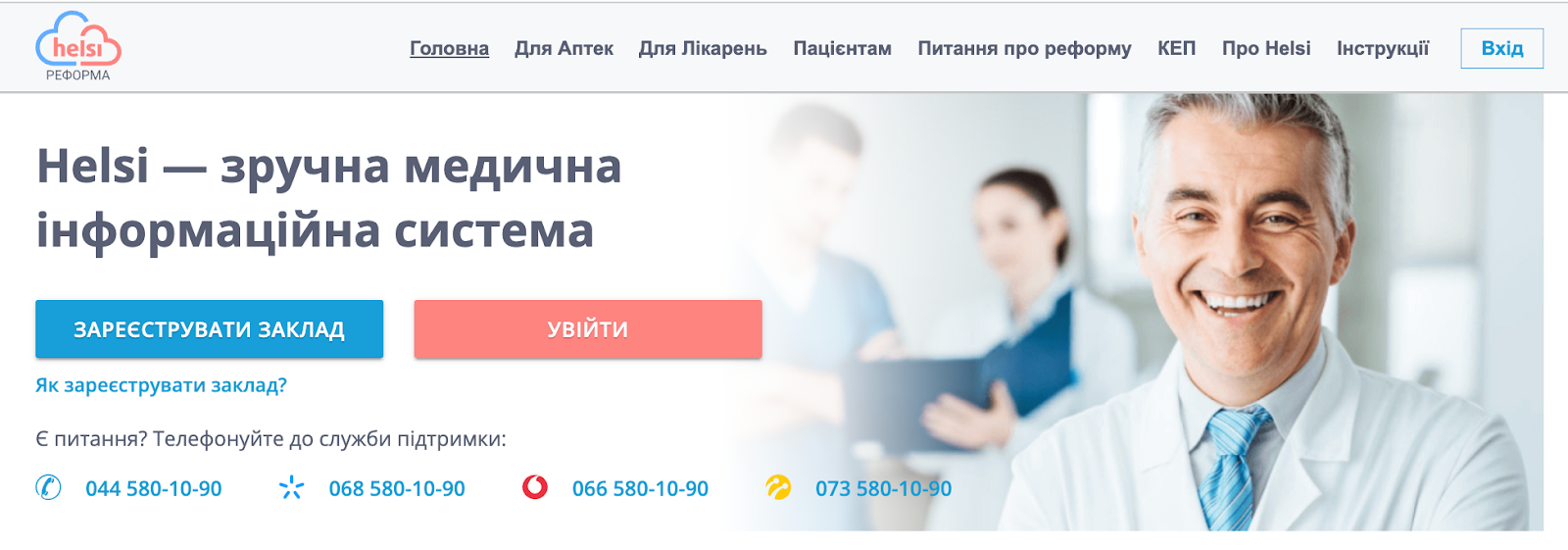
Helsi’s main development areas are deeper automation for healthcare facilities, new services for doctors, analytics for management decisions, and expanded modules for patients and medical staff.
Helsi has a strong sales team that works every day to bring on new healthcare facilities, both public and private. The team includes office-based and remote employees, who also often work in the field and travel on business.
Every day, Helsi’s sales reps handle dozens of calls with hospital directors, heads of departments and IT managers who decide whether to adopt a new medical system. A phone call is what lets them settle important questions quickly, for example:
- present the system, not just by showing the interface, but by explaining how it benefits a particular facility;
- explain how to switch from the current system to Helsi, how implementation works and how data is migrated;
- make a commercial offer, agree on contract details, and discuss discounts or special terms for the facility.
Talking by voice makes it easier to build a personal connection with a prospect. Reps can ask follow-up questions to understand their needs better and give convincing answers to a specific question or objection. Heads of healthcare facilities value a rep’s professionalism and expertise, as well as quick responses.
That’s why call recording and analysis matter so much. Being able to see how quickly and how well reps talk to clients is critical for running and growing the business and raising the level of service.
When and Why Helsi Chose Ringostat
At some point, gaps in communication became obvious. First, the existing telephony didn’t integrate with the CRM. Reps had to transfer call data into the system manually, and valuable information was often lost.
Second, when reps worked outside the office, many calls were made from mobile phones. So there was no way to track how many such calls there were, how long they lasted, or what they led to. Third, there was a problem with missed calls. No report recorded when inquiries came in, how many were lost or why, so follow-up on those calls couldn’t be controlled either.
On top of that, management had no tools to monitor how effectively reps were working.
It became clear that the company needed transparent, manageable telephony. It had to record every call, send call data to the CRM automatically, and make it possible to analyze team performance and monitor call quality.

Helsi’s management learned about Ringostat from partners who already used the service and praised its reliability. So they decided to implement Ringostat virtual telephony.
Helsi had several goals for the rollout:
- A transparent sales process: an automatic record of every call in the CRM and a complete history of communication with each client.
- Better team management by tracking the number of calls, call duration, conversion and the effectiveness of each rep.
- Better service. Call recordings make it easier to train reps, monitor the quality of conversations and respond quickly to client issues.
- Flexible, stable communication and the ability to work from anywhere in Ukraine without any drop in call quality.
The rollout went quickly and smoothly, with no lost calls or clients. Our support team helped connect the numbers, set up all communication settings, integrate with Nethunt CRM and train the team.
How Communication Is Organized at Helsi
Helsi has set up call handling to avoid chaos even with a large volume of daily communication.
Two main departments work with Ringostat telephony.
- The Sales department brings on new healthcare facilities. Reps call to present the system, consult prospects, agree on commercial offers and run demos. They also take incoming calls from prospects who have left a request or have further questions.
- The Implementation department provides technical support to new users. Its managers take calls from clients about current issues and also communicate with colleagues.
How Call Forwarding Is Set Up
Both departments use a call forwarding setup that helps them respond to inquiries quickly and avoid losing calls.
- A call always goes first to the responsible rep who already knows the client.
- If that rep doesn’t answer within the set time, the call is automatically forwarded to another employee who can pick up quickly.
- If that employee is unavailable too, the call goes to voicemail.
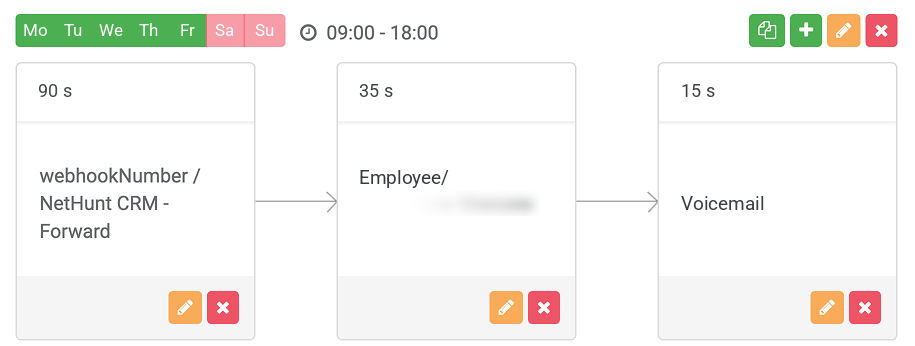
With this setup, the rep who handles the client is personally responsible for them. It builds trust, improves communication and makes sure no inquiry gets lost. Even if a call comes in after hours, the employee gets a notification and calls back.
Integrating Telephony with Nethunt CRM: How It Works and What It Delivers
Even before connecting virtual telephony, the Helsi team had a goal: automate processes as much as possible and get rid of routine manual work. They wanted a system that would store contacts and the full communication history, so reps wouldn’t waste time copying numbers or duplicating information.
Technical specialists from both services helped Helsi set up the Ringostat integration with Nethunt CRM. They quickly connected the accounts, set up data transfer, helped design the logic for creating contacts and tasks, and tested call data transfer.
Here’s how the integration works:
- For every incoming or outgoing call, a record is automatically created in the CRM: call type (incoming/outgoing), number, date/time, duration, status, call recording and responsible rep.
- If the phone number is already saved in Nethunt, the call is simply added to the existing contact.
- If a call comes from a number that isn’t linked to any contact in the CRM:
- incoming call → a new contact is created automatically with the source “Ringostat”;
- missed call → a contact is created along with a callback task, so the prospect isn’t lost.
The integration took a major headache off the team’s plate: the daily routine of moving data by hand, the confusion, the forgotten inquiries and lost tasks. The team can focus on conversations and sales. For management, it made monitoring the team easier. They can see how reps are performing, how many calls they take and make, why they miss calls and how quickly they get back to clients.
After we connected Ringostat together with Nethunt, the number of missed calls dropped by roughly 20–30%. This was possible thanks to automatic tasks in the CRM, real-time monitoring and the right distribution of calls between reps.”
The Ringostat and Kyivstar Solution: Monitoring Reps Who Work Outside the Office
Monitoring the part of the team that works outside the office has always been a major challenge for Helsi. Sales and implementation managers often travel to meetings all over Ukraine. On these trips, they often talk to clients from their personal mobile phones. This created gaps in the control system:
- it was unclear how many calls a rep actually handled and how many they missed, how long the conversations lasted and what was agreed in the end;
- there was no way to check service quality.
If an employee left the company or got sick, a colleague couldn’t pick up their client conversations because they simply had no access to the communication history.
At the same time, some Helsi reps have used their own mobile numbers from Kyivstar, a Ukrainian mobile operator, for years. Clients are used to these contacts, and the numbers appear on the website, in email signatures and on business cards. Changing or dropping such a convenient way to get in touch would have been inconvenient for everyone.
Ringostat telephony combined with Kyivstar solved the problem of staying connected outside the office. The solution made it possible to:
- keep Helsi reps’ mobile numbers within the corporate communication system;
- let reps talk freely on business trips, even with limited internet access;
- automatically send data on calls received and made from mobile phones to Ringostat;
- track missed calls and handle them on time;
- record conversations to monitor call quality;
- send call information to the CRM and store it there;
- give managers real-time access to every rep’s communication, so they can react quickly and adjust processes even when they’re out of the office.
Learn more about the joint Ringostat and Kyivstar solution in the article Kyivstar and Ringostat: How to Monitor Reps Who Work Outside the Office.
The Ringostat App: Mobility and Efficiency for Helsi’s Reps
Helsi’s reps actively use the Ringostat Smart Phone app. It’s a convenient tool for receiving and making calls that runs on employees’ computers and mobile phones.
The app is a workspace with several tabs: call history, messages from different channels (SMS, website chat, messengers), a contact book and more.
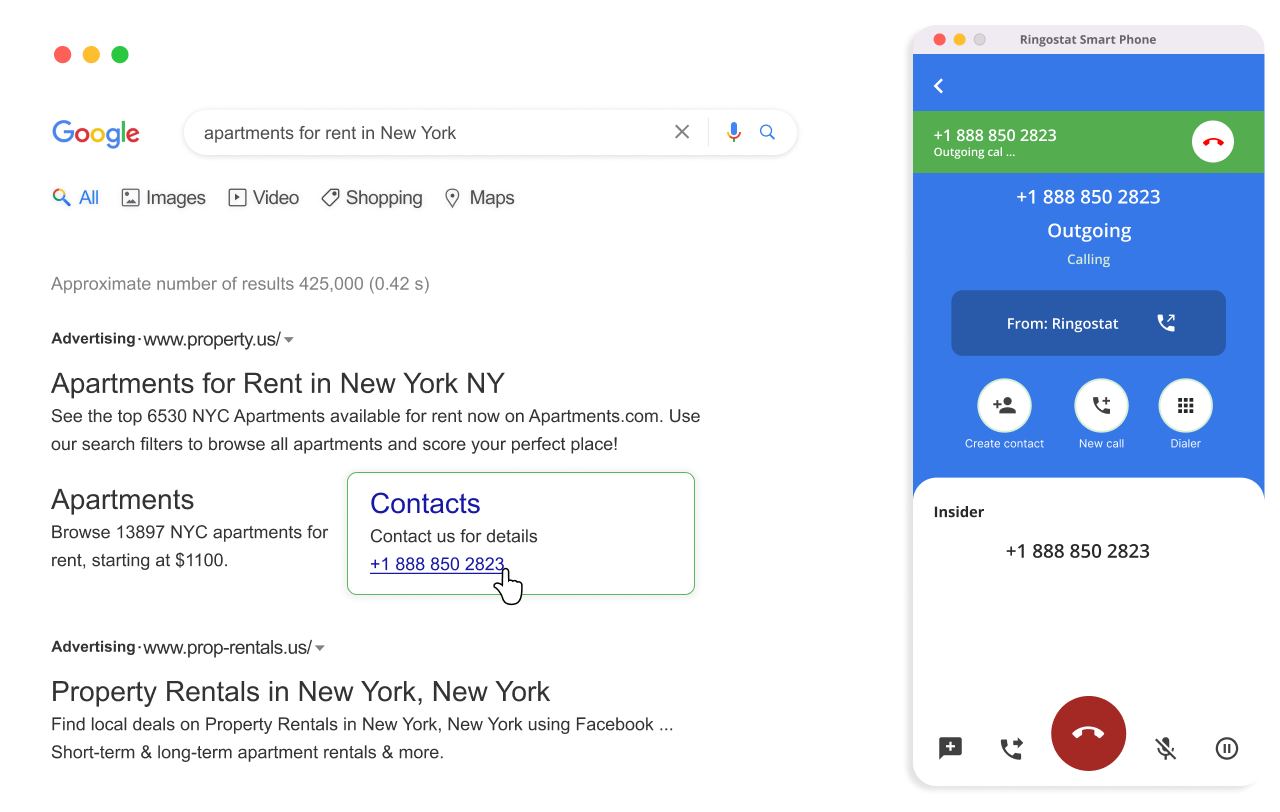
The app shows the usual data on each call: the date and time it came in, its status and call duration. It also gives extra information about the caller. This includes the page the call was made from, the last five pages viewed, information about previous contacts and more.
The Ringostat app also pulls in data from the CRM. If the number is saved in the system, the client’s name appears on the screen during an incoming call. During a call, a rep can also open the CRM in one click. This helps reps get their bearings quickly and steer the conversation with the context of the inquiry in mind. Outgoing calls made through the app are also sent to the CRM.
The app is especially handy for employees who travel to meet clients. Even outside the office, reps always have the full communication history at hand: when the client was last contacted, what they talked about and what decisions were made.
The app also lets employees talk to colleagues easily and for free. And when needed, they can transfer external calls to other employees.
Ringostat and Kyivstar: Two Tools Working Together to Stay Connected Outside the Office
The Ringostat app and Kyivstar’s solution on the SIP-PRO plan work in tandem and complement each other.
The app lets employees make and take calls over the internet. It’s an ideal solution for office and remote employees with stable Wi-Fi or mobile internet. And even during power outages, the team stays connected.
Kyivstar adds a backup on the mobile operator’s side. For employees who often travel to areas with a weak internet connection, it guarantees uninterrupted communication. Importantly, all the advantages of business telephony are kept: call recording, call forwarding, analytics and data transfer to the CRM.
With this combination of tools, Helsi’s reps can work at full capacity wherever they are, choosing whichever tool suits the situation best. And in every case, management gets transparent call analytics.
You may also be interested in the article “Hybrid Work: How a Business Can Keep Control Without Losing Flexibility” (in Ukrainian).
Ringostat Call Recordings and Reports: Tools for Analytics and Control
Ringostat reports are a key tool in the head of sales’ daily work with the team.
Daily Reports
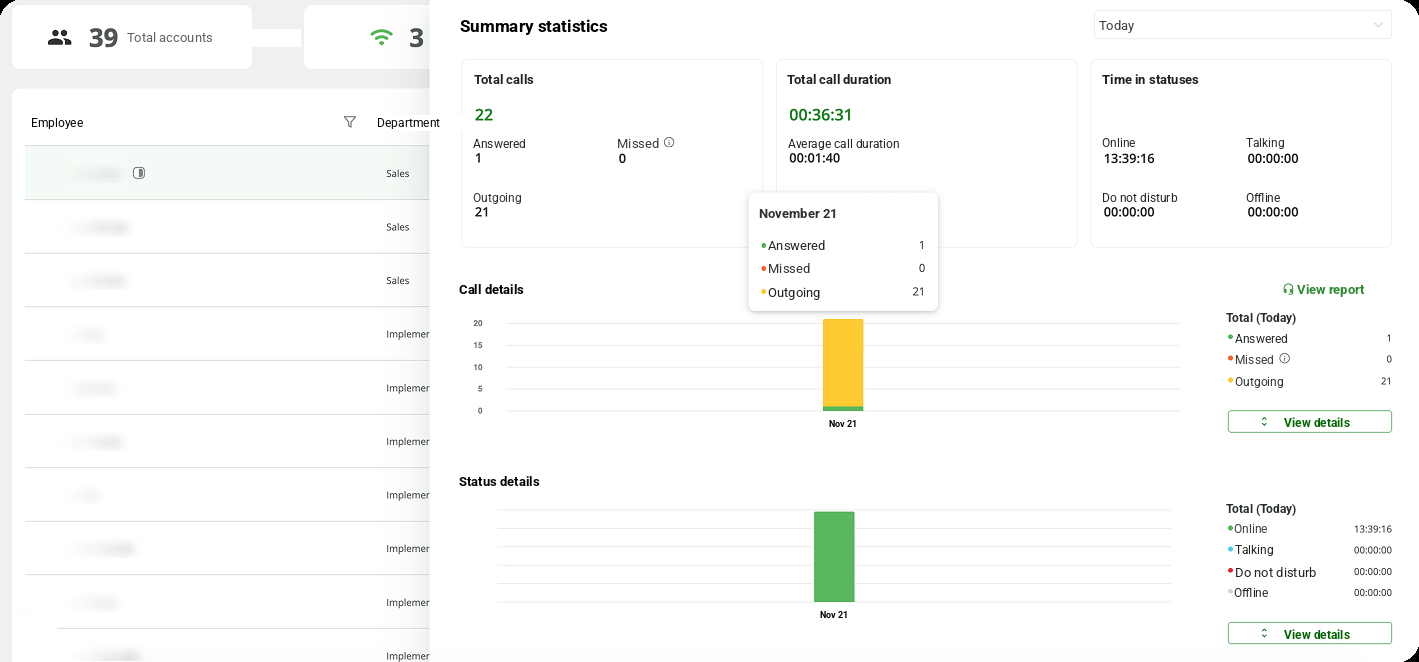
Real-time report. The head of sales constantly keeps an eye on which reps are answering calls right now, who’s free, and who’s unavailable or busy with other tasks. The report shows whether there’s a queue on the line, so the workload can be redistributed across the team in time.
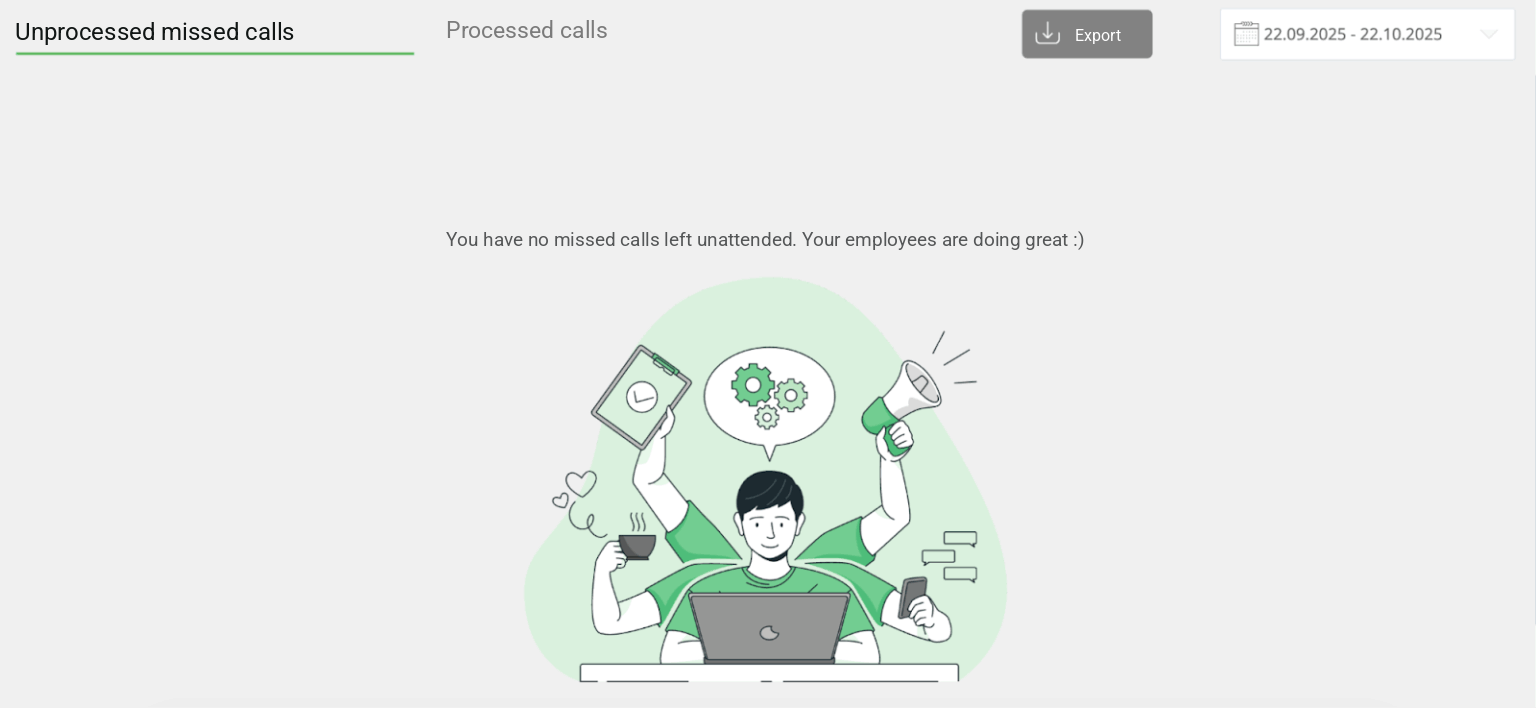
The “Missed and Unprocessed Calls” report. Every day, the head of sales checks how many calls were missed, which of them have already been handled and which are still waiting for a callback. This keeps the risk of losing leads to a minimum and helps monitor reps’ discipline. By the end of the workday, the report should be empty. That means every inquiry has been followed up and no client has been left without attention.
Weekly Monitoring
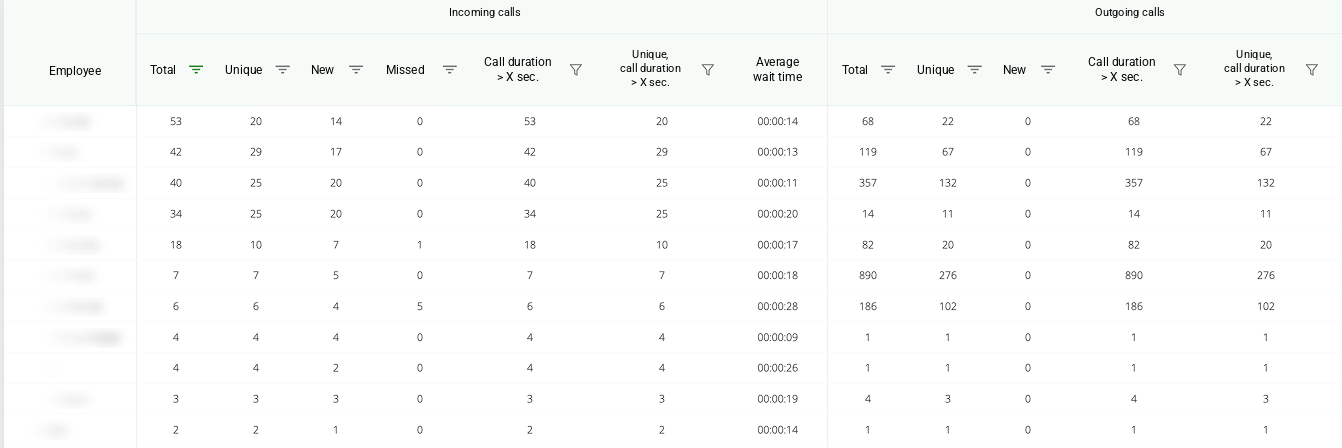
The rep performance report is one of the main tools for working with the team. It lets the head of sales manage the department based on data: who is working effectively, where the risks are, and how to improve results and increase sales. The head of sales looks at these metrics:
- the number of total and unique calls, which shows productivity and how many new clients are being reached;
- call duration, which helps assess how in-depth and meaningful the conversations are;
- missed calls, an indicator of discipline.
Monthly Team Performance Review
Every month, the head of sales takes time to analyze overall call trends. He looks at whether the number of client inquiries is growing and whether there are workload peaks to take into account when planning resources and assigning tasks.
He also compares the results of individual reps to see how each of them is meeting their KPIs compared to their colleagues. The most important performance indicators for each rep include:
- the number of new contacts;
- the number of missed calls, because they can mean losing prospects;
- conversion from calls to scheduled meetings or demos, which is what ultimately brings in new contracts.
The reports make it easy to see strong and weak reps. This makes it possible to distribute the workload sensibly, train and support newcomers, encourage productive employees and organize team training. It also helps spot a dip in performance early, for example, lots of calls but few new contacts.
How Listening to Calls Helps Helsi Improve Communication
Listening to calls shows how reps actually talk to clients. In sales of medical information systems, this matters for several reasons.
- Tone and arguments affect trust. The decision to change a medical information system is made by directors and chief physicians. They need to hear confidence, expertise and respect in the rep’s voice.
- Complex concepts and processes. The product has many specifics around implementation, migration and analytics. A rep needs to be able to explain them clearly and accurately.
- Strong competition. One poorly phrased argument can cost the whole deal.
For the Helsi team, call recordings aren’t just a control tool but a tool for continuous development. Recordings let management check whether reps follow scripts and how well they convey the product’s value. They also show whether reps ask the right questions, how they handle objections and where they make mistakes. Management understands which approaches work well and where there’s room for improvement.
For example, after listening to recordings, the head of sales noticed that one rep moved on to the product presentation too quickly. The rep asked almost no clarifying questions about the current system, needs or existing difficulties. So the director listened to the presentation “without context”. Not surprisingly, almost no meetings were scheduled.
To solve the problem, five short questions about the current system, problems, workload and key processes were added to the script. The team also took a training session on the SPIN technique and active listening.
The results:
- this rep’s call-to-demo conversion almost doubled;
- repeat calls with follow-up questions fell by 40%;
- directors of healthcare facilities were more willing to agree to meetings because they felt a personal approach.
So listening to calls showed that the problem was in how the conversation was structured. Adjusting the script significantly improved communication quality and conversion.
Listening to calls also revealed weak spots in the presentation. For example, directors of healthcare facilities regularly asked: “Do you help with data migration when switching to Helsi?” It became clear that the topic wasn’t covered well on the website. The team added a section on data migration to the website and included the message in ads and scripts. The number of repeat questions dropped noticeably.
Results of Using Ringostat and Kyivstar
After connecting Ringostat, the Helsi team saw positive changes right away. Reps began working faster and with more confidence and stopped losing contacts. Clients noticed clear communication without delays or interference, and management got complete data for analysis.
Here are some of the most important results in numbers.
- The number of missed calls dropped by roughly 20–30%. Reps began handling all inquiries promptly, not just the most convenient ones.
- The number of contacts grew by 15–20%. Before, these prospects were simply lost due to a lack of control.
- Call-to-demo conversion grew by 10–12%. Heads of healthcare facilities feel the engagement of reps who are always reachable, and they don’t consider competitors’ offers.
All of this has a positive effect on the platform’s reputation among healthcare facilities.
Helsi doesn’t yet use the full potential of the Ringostat system, but it already plans to test speech analytics. This functionality could make work even easier for the team and management by automating call analysis, sentiment detection, key phrase detection and recommendations for reps.
Helsi intends to set up its own checklists for reviewing calls, so AI can assess whether the right questions were asked, whether the script was followed and whether client objections were recorded. For Helsi’s sales model, this will be an important step forward and a significant system upgrade.
