


Orders keep growing, customer expectations keep rising, and sales teams are stuck trying to do two things at once: answer fast and sell well. In May, missed inbound calls among Ringostat clients reached 15%. In conditions like these, businesses often stop looking for “more people” and start looking for a different way to keep up the pace. In e-commerce, the gap between speed and available resources is especially sharp. This case study looks at how an AI Voice Agent is helping the electronics retail chain TI close that gap.
Meet the Company
TI launched in 2011 in Kharkiv as a single small kiosk selling accessories. Today it’s a large nationwide Ukrainian retail chain with dozens of locations — kiosks, showrooms, and flagship stores — plus an online store carrying 18,000 products.
The entire customer journey, from placing an order to post-sale support, runs through TI’s sales team. It’s split into three groups: B2C, B2B, and quality control. The first focuses on retail customers, the second handles corporate clients, and the third manages customer support, including exchange and return requests. Together, more than 20 employees handle customer inquiries and communication every day.
The Business Challenge
In the electronics market, retailers often sell the same products, so competition increasingly comes down to service rather than range. But that service doesn’t exist in a vacuum — it’s under constant pressure from wartime team burnout, a growing number of credit applications, and a parallel rise in rejections that make customer communication even harder. As a result, response speed isn’t just a metric anymore. It’s the point where a business either keeps a customer or loses them within the first few minutes.

This is usually where AI solutions start to appear — not as a separate initiative, but as a response to a load the system can no longer handle on its own. Voice agents like the AI Voice Agent are a case in point: they take over routine calls and part of real-time customer communication.
AI Voice Agent is Ringostat’s virtual sales manager. It calls customers or answers inbound requests on its own, confirms details, sends payment or purchase reminders, qualifies leads, and logs the outcome of every conversation.
It’s effectively another team member — one that works around the clock, never calls in sick, and takes on the layer of communication that’s hard to scale without constantly growing headcount.
Why TI Decided to Implement an AI Voice Agent
At first, this looked like an attempt to optimize one specific part of the process — simply taking excess calls off sales managers’ plates. But it quickly became clear this wasn’t a single task. It was an entire layer of routine work that was steadily eating into the team’s focus.
Over time, another layer of the problem became just as clear — it wasn’t only about time. It was also about how much attention got split between actual sales and the operational side of customer support.
According to Kateryna Shafran, this routine work used to cost managers an hour and a half to two hours every day. After an order was placed, they’d call customers just to let them know it was ready for pickup.
That was time that could have gone into new sales, but instead it disappeared into routine calls. As call volume grew, both the speed and quality of handling new inquiries started to suffer. That’s when the company decided to hand this part of the job over to the AI Voice Agent.
Scaling Without Hiring New Staff
Given wartime realities, TI isn’t just solving for efficiency on a task-by-task basis — it’s thinking in terms of the whole system: how much the company can handle without expanding the team or letting service quality slip.
Splitting the Workload Between the AI Voice Agent and Sales Managers
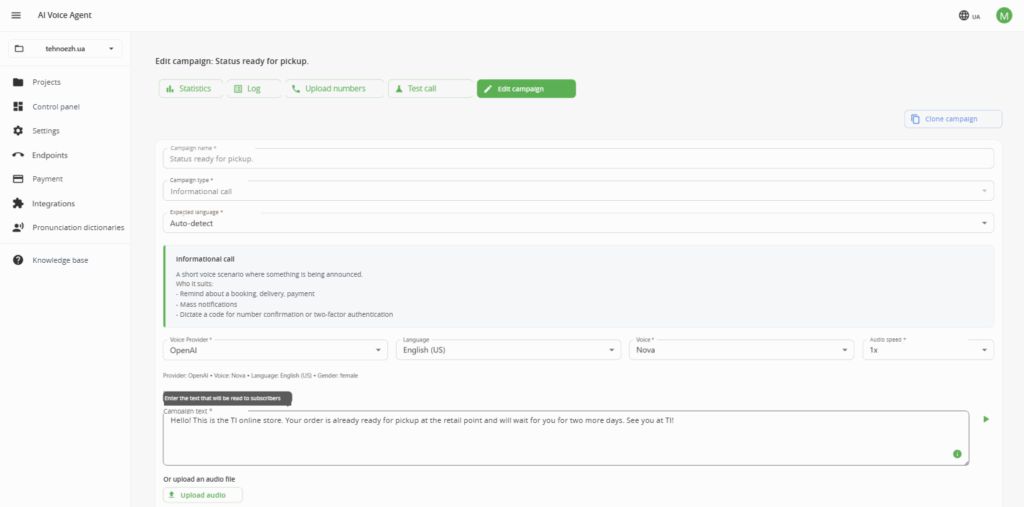
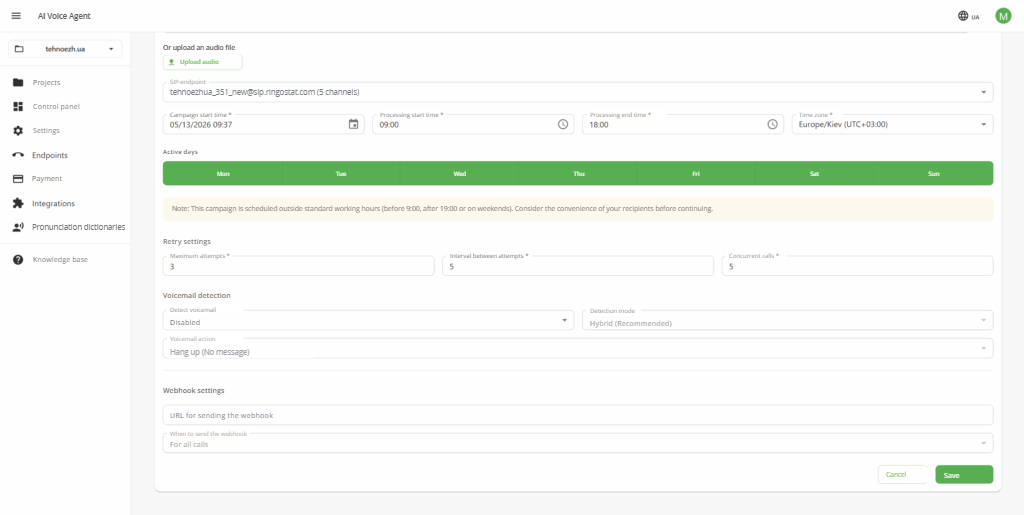
TI’s team drew a clear line between what could be automated without losing effectiveness and what needed a human touch because of how much the contact itself mattered. They use the AI Voice Agent’s outreach campaign feature to let customers know their order is ready for pickup.
It’s not a single, static script — it’s several touchpoints spread out over time: an initial “Ready for pickup” message as soon as the status changes, follow-up reminders after two and three days, and a final message the day before the courier service’s storage deadline. As a result, 58.3% of these calls succeed.
At the same time, the decision to use the virtual manager only for status updates isn’t about technical limitations. It comes down to business reality: different types of calls carry different weight. Some directly affect margins and future sales, while others surface the reasons behind cancellations and returns — insight the company needs to improve the system as a whole.
According to Kateryna Shafran, the company deliberately doesn’t hand every communication scenario over to the AI Voice Agent. Some calls have a direct impact on margins, gross profit, turnover, and upsells, so those stay with human managers. Understanding why customers don’t pick up their orders is critical for the business. That’s why the AI Voice Agent handles customer updates for the first three days after an order becomes ready, and a manager steps in on day four.
This approach doesn’t just keep the service running — it also produces solid analytics. TI now tracks more than 40 reasons customers cancel or don’t collect orders, analyzes how these trends shift, and monitors how they change depending on market conditions.
AI Voice Agent Results
The AI Voice Agent has effectively become part of how TI’s operations team runs its economics. This comes down to very concrete numbers: how much time goes into routine calls, how that scales across hundreds and thousands of contacts, and what the company gets back in resources.
The second part of the story is about process stability and how manageable customer communication has become. What matters isn’t just that calls are automated — it’s how they affect customer behavior, and whether the company can fine-tune them without sacrificing service quality.
Takeaways
This case makes something clear: automation in e-commerce is rarely about replacing people. It’s almost always about working alongside them, just with roles redistributed differently.
TI hasn’t really changed its operating model. What it removed was noise — the repetitive calls that ate up hours without adding any new value.
Once that noise is gone, the actual business process becomes visible, along with ways to improve it, without that constant feeling that the team “can’t keep up.” The most interesting part here isn’t the 193 hours saved every month. It’s that, for the first time, those hours stopped being losses the team simply had to accept as normal.
