


15 hours a week — that’s how much time DiFFreight now saves on manually reviewing calls. After adopting eniq.ai, the team automated quality control for their conversations and freed up that time for other tasks. Over the course of a month, that adds up to roughly 60 hours — nearly a week and a half of work.
Previously, the team lead listened to calls manually every day, spending up to three hours on this alone. Now the system analyzes conversations automatically. This case study looks at how DiFFreight set up this process and the role Ringostat’s telephony played in it.
- About the Company
- The Business Challenge and the Need for Automation
- Getting Started with Ringostat
- How the Team Handles Customer Inquiries
- Call Routing
- Tracking Missed Calls
- Automated Quality Control with eniq.ai
- How the Analysis Works
- How Reps See Their Results
- Using the Data for Training and Management Decisions
- Integration with KeepinCRM
- Results and Key Takeaways
About the Company
DiFFreight is a Ukrainian logistics company that organizes international freight shipping for businesses. The company works with China, the US, Canada, and various European countries. But shipping is only part of what they do — the team also helps clients find and purchase goods in China, inspect them, handle customs clearance, and manage warehousing and delivery.
For the client, all of this feels like a single, seamless process. A personal account integrated with the company’s ERP system lets customers track every stage of delivery.
The Business Challenge and the Need for Automation
The problem with call analysis wasn’t just the amount of time manual review took. With 74 employees, the team lead simply couldn’t cover every conversation — in practice, less than 5% of calls were ever analyzed.
As a result, feedback often came too late. Mistakes could be identified after the fact, but there wasn’t always time to fix things with the client. On top of that, spot-checking calls didn’t give a full picture across the team: which phrases came up most often, where sales reps deviated from the script, and whether their communication actually improved after feedback.
What DiFFreight needed wasn’t just a faster way to listen to calls — it needed systematic quality control that covered every conversation and let the team address mistakes at scale.
Getting Started with Ringostat
DiFFreight had worked with another telephony provider before, but the team grew increasingly unhappy with the quality of support and started looking for an alternative.
They found Ringostat through a Google search. Beyond call functionality, the team paid close attention to call analytics, how convenient the reporting was, and the level of support after onboarding. DiFFreight first connected telephony, call tracking, and callback, and added eniq.ai — the AI communication analysis tool — later on.

How the Team Handles Customer Inquiries
The customer journey at DiFFreight runs through a three-tier system:
- the call center takes the first inquiry and clarifies the shipping country, estimated volumes, and where the client is in the process;
- a sales rep dives deeper into the request, calculates shipping costs, and picks the right route;
- the service department takes over from there — delivery status, documents, and any ongoing questions.
Because of this structure, one client might end up talking to several different employees. That’s not duplicated work — each person is simply responsible for their own stage of the process.
While DiFFreight relies on other communication channels too, including messaging apps and email, calls remain the primary way the company connects with clients and partners.
That’s why it’s critical for every call to reach the right person immediately: a returning client should reach their assigned rep, a new lead should go to the right department, and a carrier should be connected with the logistics manager handling that specific shipment.
Call Routing
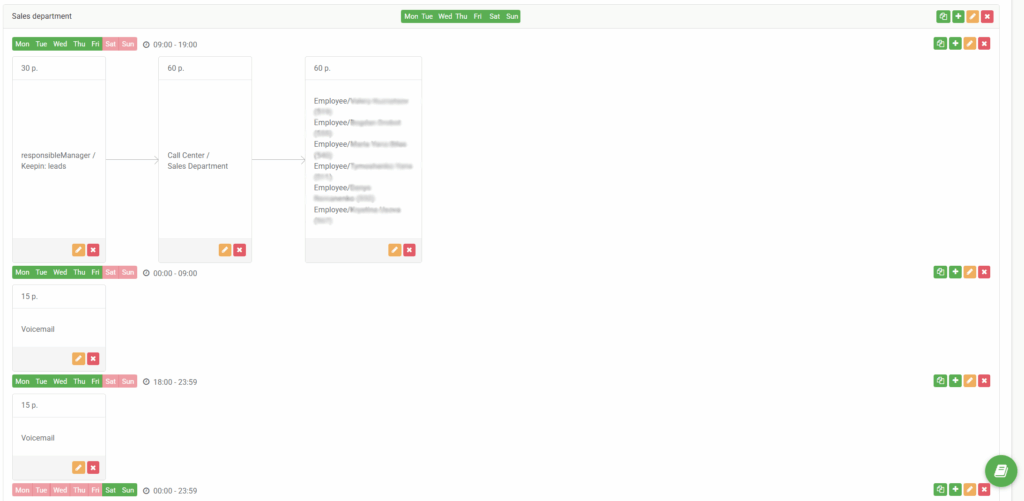
According to DiFFreight’s commercial director, without clear routing, missed calls would pile up, and the company would need to hire dedicated staff just to distribute incoming calls.
That’s why every sales rep has a personal number while also staying connected to shared lines — for calls coming from the website and callback forms. Logistics managers are connected to the phone system too, so the company can track not only client conversations but also communication with carriers.
For the client, though, what matters most is something else: once their request is being handled by a specific rep, the next call goes straight to that person — no repeated explanations, no wasted time.
Most employees take calls through the Ringostat Smart Phone app, integrated with the company’s ERP system. This lets sales reps make calls directly from their work environment, wherever they happen to be.
Part of the team, logistics managers in particular, works through the MicroSIP client, since their main use case is placing regular calls to carriers at fixed numbers. Regardless of the tool used, every call is logged and recorded for later analysis.
Tracking Missed Calls
At DiFFreight, handling missed calls is its own dedicated process.
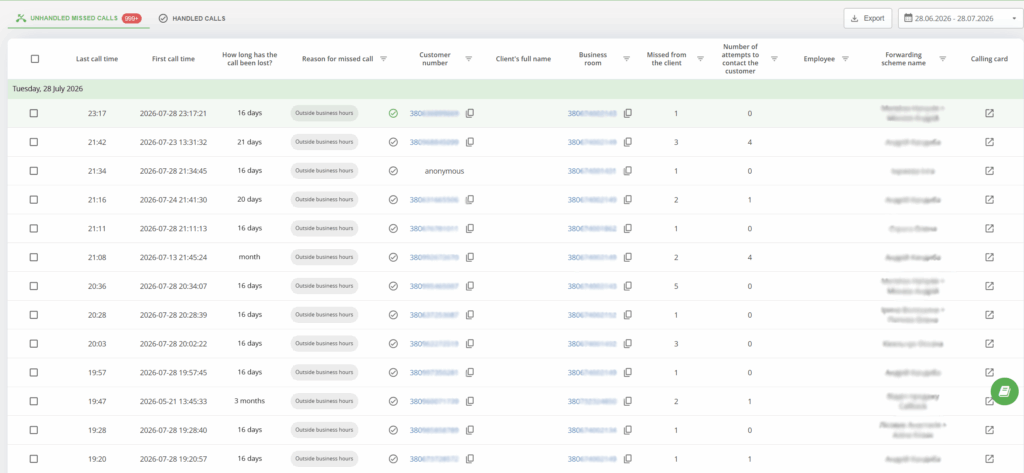
For every call, the system records whether it’s been handled, why it was missed in the first place, and who called the client back. As a result, no inquiry slips through the cracks, and managers can keep track of how well their teams follow up on these situations.
Automated Quality Control with eniq.ai
When the team was smaller, quality control worked the traditional way. The team lead manually listened to recordings, checked whether reps followed the script, and evaluated how well each call was handled and whether it achieved its goal. Over time, this approach became a bottleneck.
Other external tools the company tested didn’t fully solve the problem either. They collected statistics but left the manager alone with spreadsheets that still needed to be analyzed manually. That’s when DiFFreight decided to bring in eniq.ai.

How the Analysis Works
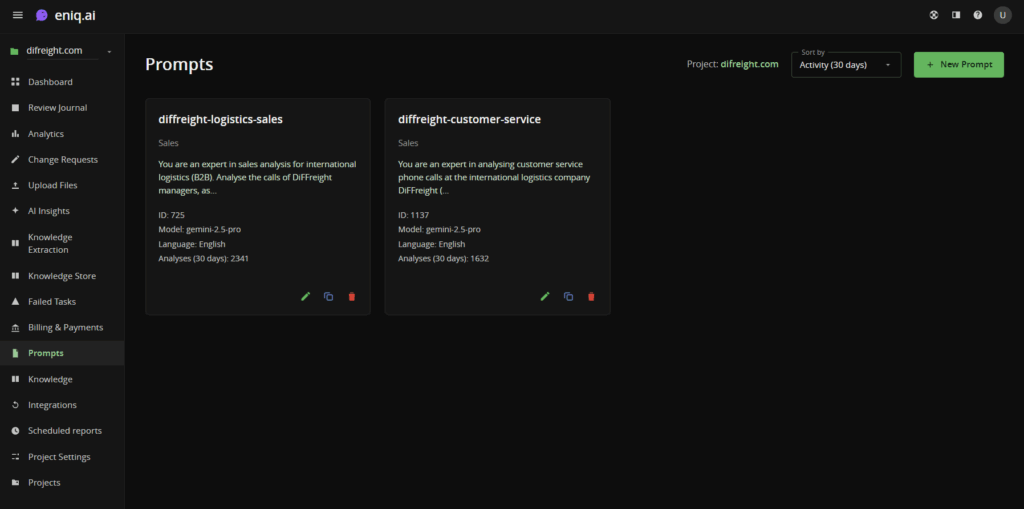
DiFFreight currently runs two analysis checklists: one for the customer service department and one for sales, each with its own set of criteria the AI uses to evaluate that specific type of conversation.
That said, the way we work with the analysis results is similar across both departments. Most of the heavy lifting falls to our sales coach, who reviews call scores, identifies recurring mistakes, and shares findings with team leads and reps. These results shape training decisions, individual and group review sessions, and how we evaluate a rep’s growth within the team.”
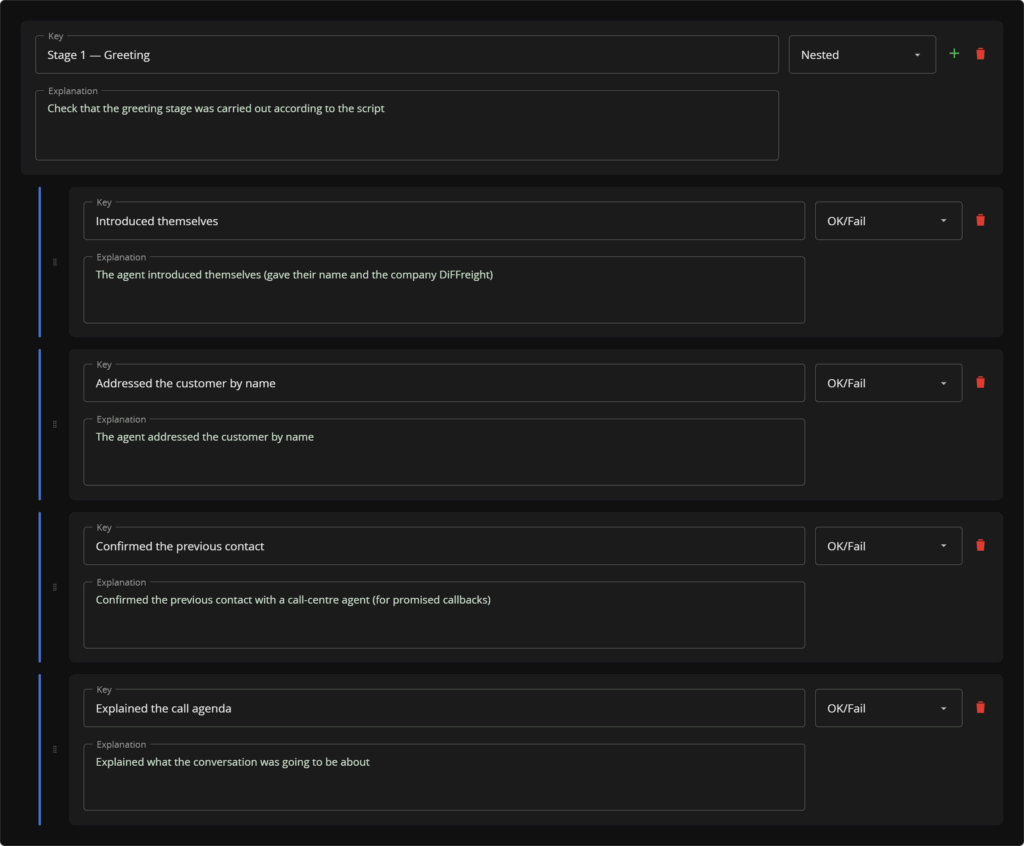
eniq.ai doesn’t just run through a checklist mechanically. For every item, it generates either a specific score or records a concrete fact.
For example, in the sales checklist, the system checks whether the rep greeted the client according to the script.
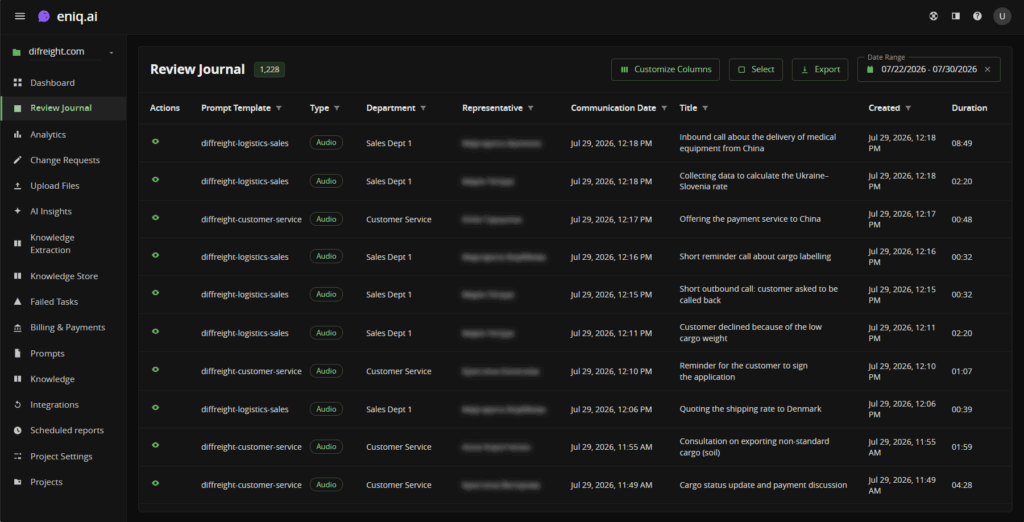
All analysis results are collected in a log — a table where a manager can find any call they need within a few clicks, filtering by rep, date, type, or score.
How Reps See Their Results
After each call, DiFFreight reps receive a score and a report in Telegram — the team chose this messenger for the integration — so they get feedback almost immediately rather than after a long delay. If a rep disagrees with a score, they discuss the specific call with the sales coach, who either explains the mistake or adjusts the result.
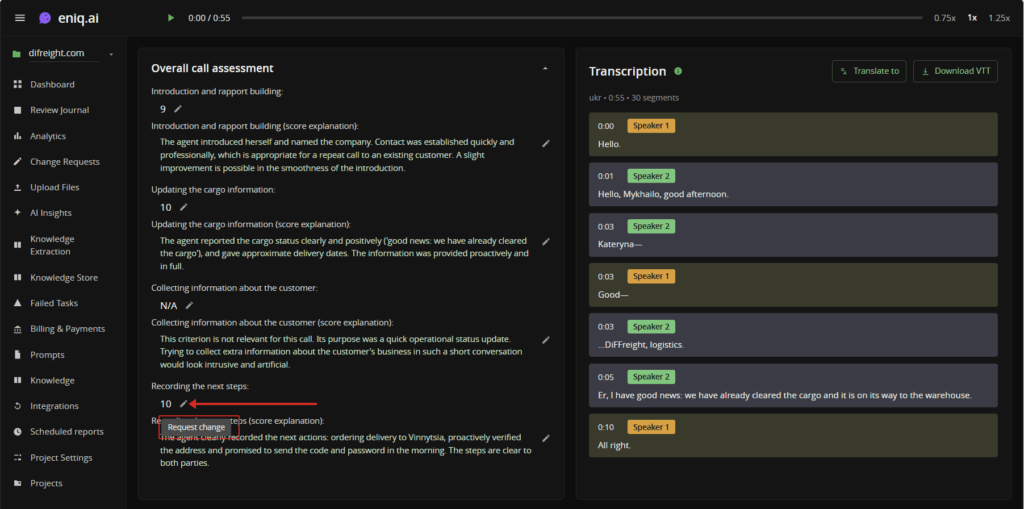
If a sales rep’s call scores below 5 points, a notification is sent right away. At first, these alerts went to the team’s shared chat, but the company later switched to sending individual messages to each rep — a change that made it possible to respond to weak calls much faster.
Using the Data for Training and Management Decisions
At DiFFreight, the sales coach regularly reviews eniq.ai scores, identifies common mistakes among reps, and runs individual and group call reviews. Sales and service team leads receive automatic weekly reports with the team’s average scores, which makes it possible to track each rep’s progress over time and plan additional training when needed.
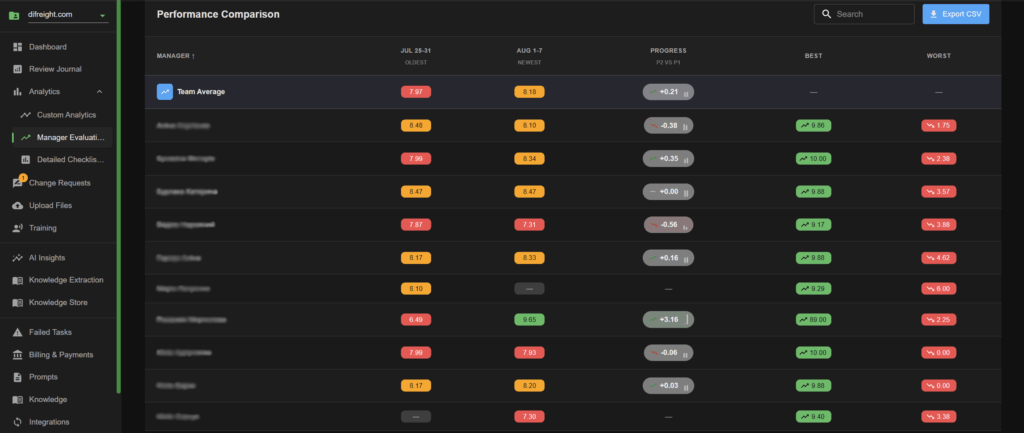
The system also builds a detailed report based on the checklist itself. It can include any metric that matters to the team: use of banned phrases, quality of greetings and introductions, needs discovery, client consultation, and more. This makes it possible to see, over time, exactly which stage of a conversation reps tend to struggle with, or where they perform best. That gives managers a clear sense of how much their team is progressing over a given period.
Another report type is trigger-based. A trigger could be a low call score, the use of a banned phrase, a mention of a competitor, or any other event a manager wants to know about right away. These alerts mean managers don’t have to check the dashboard manually — the system flags anything important on its own.
At the same time, eniq.ai doesn’t just surface problem calls — it also helps find the best ones. Top-scoring calls can be used to train new hires, refine scripts, and build a library of best practices. Managers often ask reps to pick out their own strong examples, but in practice, this task tends to get postponed or skipped altogether. Automatic selection saves time for both managers and the team, and new hires get access to strong communication examples much faster.”
eniq.ai scores don’t just sit there as statistics. The company factors them into its overall rep rating and tracks how the quality of client communication changes over time.
Integration with KeepinCRM
Ringostat’s telephony is integrated with KeepinCRM, so reps can see their entire communication history right inside the CRM — call counts, call duration, and recordings they can listen back to whenever needed.
Separately, the team also uses an integration with its internal ERP system. While the ERP handles operational processes, KeepinCRM is where the company tracks and analyzes rep communication.
DiFFreight set up both integrations on its own, though the Ringostat team is available to help with technical implementation and additional configuration whenever needed.
eniq.ai can also automatically generate comments after every call and push them into the CRM. DiFFreight isn’t using that particular feature yet, though.
We’re not using this feature to its full potential yet, but we see it as an important next step in automating our processes.”
Results and Key Takeaways
At DiFFreight, telephony has become more than just a tool for making calls — it’s now part of the company’s operating system. It helps route inquiries correctly, keeps missed calls under control, and gives managers a complete picture of how their team is performing.
Call quality used to depend entirely on how many calls the team lead could get through in a day. Now it’s a continuous process: eniq.ai automatically reviews every conversation, checking script adherence, call objectives, and banned phrases. The company saves around 15 hours a week and no longer needs a dedicated person for manual call quality control.
That said, it took the system about a month to go through full setup and adaptation. After that, results became stable, and using the scores to develop the team got a lot easier.”
