


In real estate, two types of businesses usually operate — developers and agencies. Each has its own processes: developers attract clients through advertising and handle calls in the sales department, including remotely, while agencies rely on real estate agents who work with clients directly, often from mobile phones. Kvartal Development combines both models in one business, which means the company has to solve different tasks for both directions at the same time: control conversations, track the source of calls, and automate processes. In this case study, we explain how Kvartal Development, together with its partner G-plus, built a comprehensive system based on Ringostat that makes it possible to manage communication, marketing, and sales — separately for the developer and the agency, but within a single environment.
- About Kvartal Development
- Two sales models — two different tasks
- Why don’t standard solutions work?
- How the solution was chosen: Ringostat and G-plus CRM
- How communication is set up at Kvartal Development
- How integration unites processes: all communication in one space
- One system for sales, communication, and marketing
- Reports and team performance control
- Reliable connection during energy crises
- Results: one communication system for two different businesses
About Kvartal Development
Kvartal Development is an investment and development company that has been building residential complexes and selling real estate in the Kyiv region for over 10 years. The company works in a full-cycle model: it handles development, construction, and housing sales through its in-house sales department and real estate agency.
“We have a real estate agency that over time grew into a construction company. We started with selling properties, and then began implementing our own development projects,” says Yurii Motsar, Head of Sales. Today, the company develops both directions in parallel — as a developer and as a real estate agency.
Over this time, Kvartal Development has delivered six residential complexes — 13 apartment buildings, 54 townhouses, over 370 apartments, and 21 commercial premises. Several more projects are under construction. In total, the company has already built or is building over 50,000 square meters of real estate, and more than 1,000 families already live in its buildings.
The developer’s main project is the Kvartal Soborna residential complex. The developer manages all stages of delivery independently — from design to apartment sales.
Two sales models — two different tasks
Developer: advertising, calls, high lead cost
To attract clients, Kvartal Development uses paid ads in Google and Meta, real estate websites, partner platforms, and its own website.
Most inquiries after advertising are calls. Potential buyers call to clarify details: layouts, prices, installment terms, or to arrange an apartment viewing. It is important to answer all calls without losing a single inquiry, because a missed call may mean losing contact with a potential buyer who will simply call another developer.
It is also important to track the advertising source of each call to understand which advertising channels, campaigns, keywords, and banners really work — and which waste the marketing budget. Without call analytics, it is almost impossible to evaluate what actually works and make budget allocation decisions.
In real estate, each lead is expensive, and the deal cycle can last for months. Clients often compare different options, call several developers, and return to the conversation multiple times. The path to the deal sometimes takes months, and throughout this time you need to stay in constant touch with the client, remember every detail and agreement, and keep the context.
So for a developer it is critical to:
- answer all calls and not lose a single inquiry;
- understand which ads generate calls;
- track the effectiveness of each channel;
- keep the full communication history.
Agency: remote agents, calls from mobile phones, and the need for control
In the real estate agency direction, the process looks different. The key role belongs to agents, who spend most of their time outside the office: they show properties, meet clients, consult them. Communication with clients happens mainly via mobile phones. After all, a call most often becomes the first step to meeting a client, and later — the main communication channel.
This is a classic model, but it has a drawback: the company practically has no control over agents’ communication with clients:
- calls are not recorded in a single system;
- the communication history with a client is stored only on the manager’s phone;
- it is impossible to control and analyze work with leads;
- it is impossible to assess the effectiveness of agents’ work.
- As a result, some inquiries are lost, and the quality of the team’s work depends on each individual employee.
Why don’t standard solutions work?
Before implementing Ringostat, Kvartal Development already used other telephony services, including Binotel. But as the business grew, that was no longer enough.
Some calls stayed outside the system, in particular agents’ communication with clients from mobile phones. In addition to paid ads, real estate listings were also posted on different platforms, but it was unknown where inquiries were coming from, which made it harder to evaluate advertising performance.
In practice, marketing and sales worked with different data and could not synchronize processes.
So Kvartal Development needed not just new telephony, but a system that combines all customer touchpoints: records calls regardless of who calls and from where, sends this data to the CRM, and allows analyzing it together with advertising.
That is exactly what the integration of Ringostat telephony, FMC for mobile employees, and G-plus CRM delivered.
How the solution was chosen: Ringostat and G-plus CRM
So the key challenge for Kvartal Development was to combine two different businesses into one efficient system: the work of agents and the work of the developer’s sales department, which processes inbound inquiries from ads.
And it was especially critical to set up call handling for the agency — to keep the flexibility agents have when speaking from their own mobile phones regardless of location, but at the same time not lose control over communication.

That is why Kvartal Development first focused on choosing telephony as the foundation for all communication. After implementing telephony, the next step was choosing a CRM that could unite all processes in one system. This is where Ringostat’s partner G-plus joined the project — an industry CRM system for developers, built with real-life development processes in mind.
and only then started looking for a CRM that could cover two different businesses for us,”t too expensive for a real estate agency.”
Unlike generic CRMs, G-plus lets you work not only with clients, but also with real estate units. In the system, you can manage apartments and commercial premises, control statuses (for example, available, reserved, sold), manage sales and installment plans, and synchronize this data between the website, the sales department, and marketing. Separately, the system includes the so-called “chessboard” — a visual building scheme that lets you quickly see the status of each apartment and manage sales by floors and sections.

The key task we solve for a developer is having everything in one place. Not the website separately, not tables or CRM separately, but one system where you have sales, communication, and all the industry tools a developer needs”.
For Kvartal Development, this meant the ability to combine in one system:
- real estate inventory management;
- work with leads;
- communication with buyers;
- tracking marketing sources of inquiries.
An important part of this ecosystem was the integration with Ringostat, which made it possible to automatically send call data and advertising sources to the CRM.
Additional advantages of the solution, appreciated both by the vendor and the client, were the following:
- the ready-made integration did not require custom development;
- the implementation process relied on Ringostat’s ready resources;
- Ringostat support removes part of the operational workload from the integrator and the client.
As a result of the integration between G-plus and Ringostat, Kvartal Development got a single system that unites sales, communication, and marketing — and gives full control over both the sales department and mobile agents.
How communication is set up at Kvartal Development
Developer communication: call control and advertising analytics
Call handling scheme: no missed inquiries
A convenient call forwarding scheme is set up for the sales department. A call always first goes to the responsible manager who handles the client and knows the details. If the manager doesn’t answer within 30 seconds, the call is automatically routed to the call queue. At the end of the routing chain, three backup numbers are connected — ensuring that the call always reaches someone who can assist the client, even if the responsible manager is busy or in a meeting.
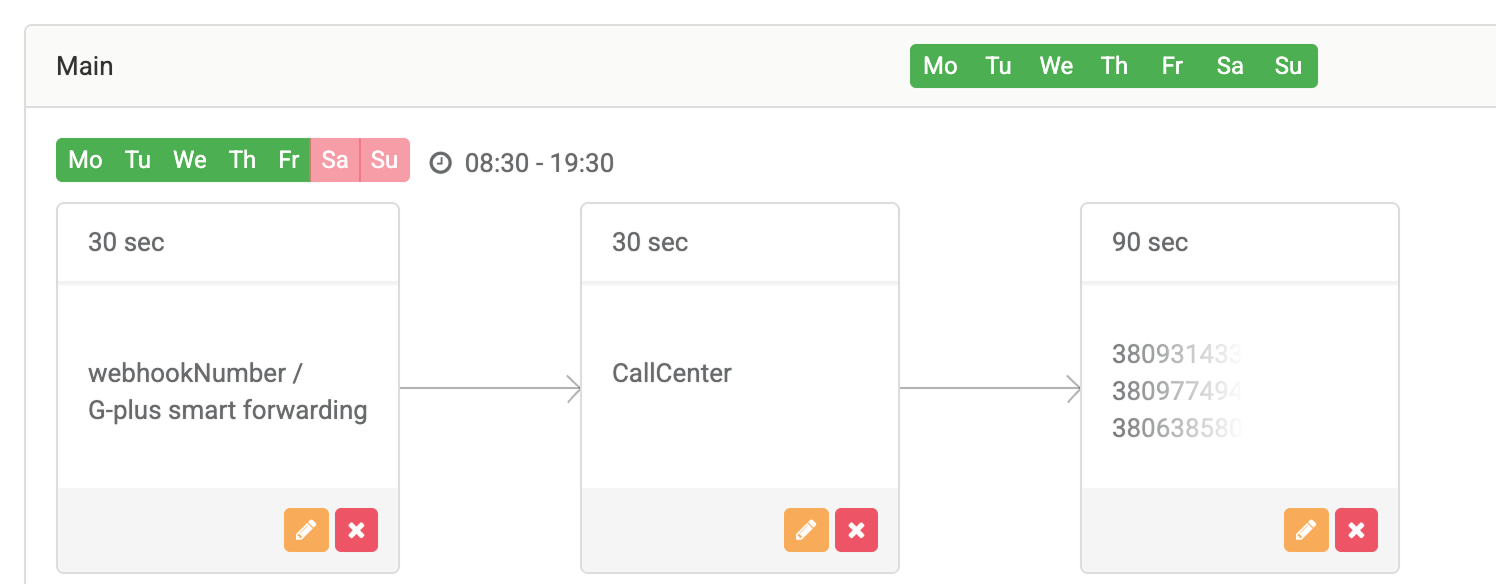
That is why the company built the system so that it is almost impossible to miss a call. Every client will get an answer even during peak periods or when managers are busy.
Ringostat Smart Phone: communication context before you even pick up
Managers handle calls via the Ringostat Smart Phone app. It is a mobile and desktop calling app, so even if managers have to leave the office for meetings or property showings, they stay connected and do not lose access to the system.
The app is also a “smart assistant” for a manager: it shows all information about a client before they pick up the phone. During an incoming call, the system immediately shows key information about the client. Before the manager answers, they already know:
- the client’s name, so the manager can address the person by name right away;
- a link to the CRM record, so the manager can open the system with one click;
- the history of previous inquiries;
- the call source and other valuable insights about the caller.
The manager does not waste time clarifying basic details and can immediately move to a meaningful consultation.
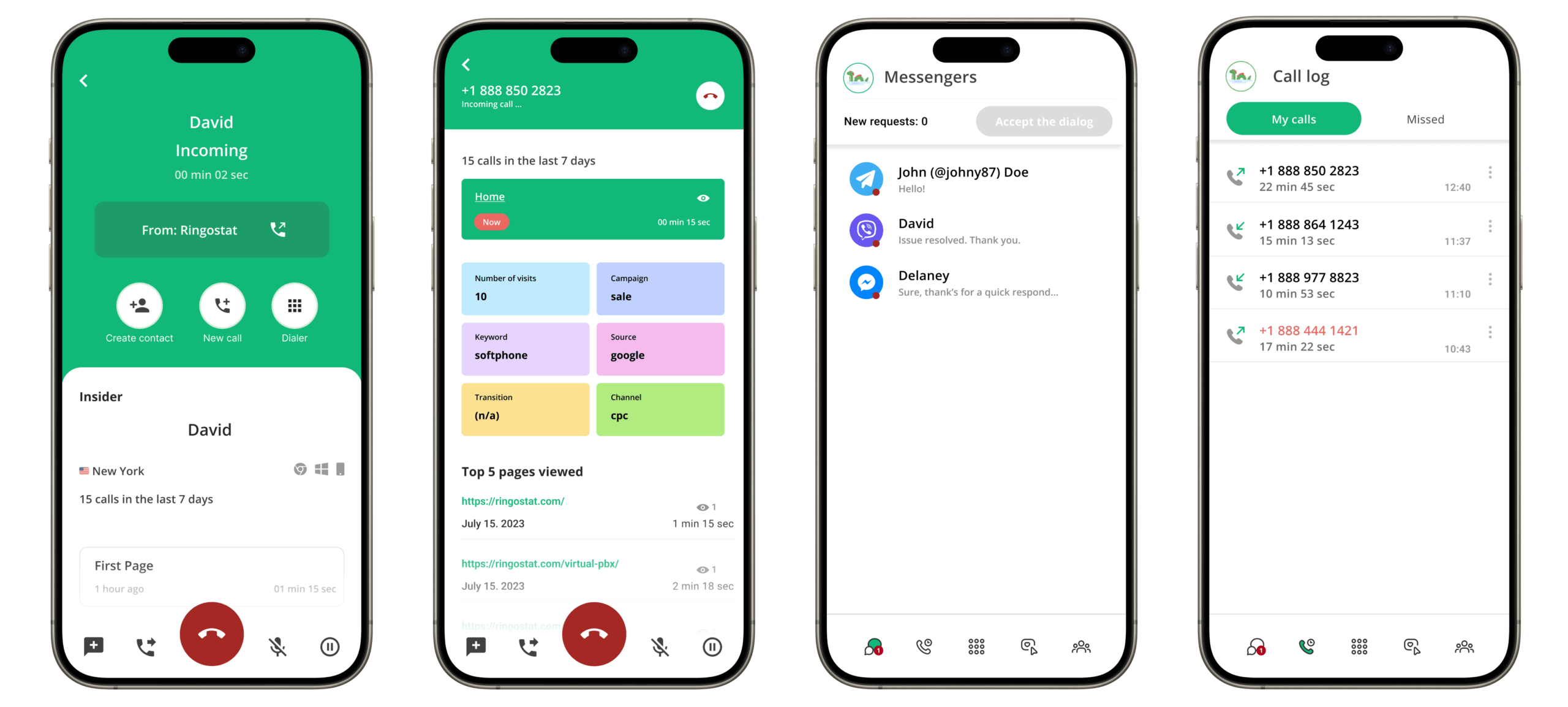
For example, the app shows which advertising campaign — and even which keyword, banner, or ad — brought the client. Even if the person is calling for the first time, the manager immediately understands what exactly attracted the potential buyer: a specific promo, an apartment, a residential complex. This makes the first conversation more precise and professional, and the client feels that the company understands their request well.
Such insights are also important when a client calls again, especially when the call is answered not by the responsible manager but by a colleague. They can also open the CRM in one click and immediately see the full communication history: previous calls, manager notes, request details. This way, they can continue the conversation with the background in mind — for example, which apartments the client considered, what was agreed earlier, which questions were already discussed. For the client, it looks like seamless communication with the company, even when different employees talk to them.
Call tracking: which ads bring calling clients?
In real estate, each call is an expensive lead and a potential buyer. To manage advertising campaigns more effectively, Kvartal Development uses Ringostat call tracking. It substitutes the number on the website, which makes it possible to accurately identify the source of each inquiry — down to the keyword that brought the client — and understand where people are calling from: search ads, social media, real estate marketplaces, and other sources.
The system uses both static and dynamic number insertion, which makes it possible to track call sources from different advertising channels:
- static numbers are used for specific sources and platforms, like OLX and DIM.RIA, where it’s important to track the inquiry flow consistently, as well as for banner and print ads;
- dynamic call tracking substitutes the number on the website, which makes it possible to accurately identify the source of each inquiry — down to the keyword that brought the client.
Call tracking data is visible in Ringostat call log reports:
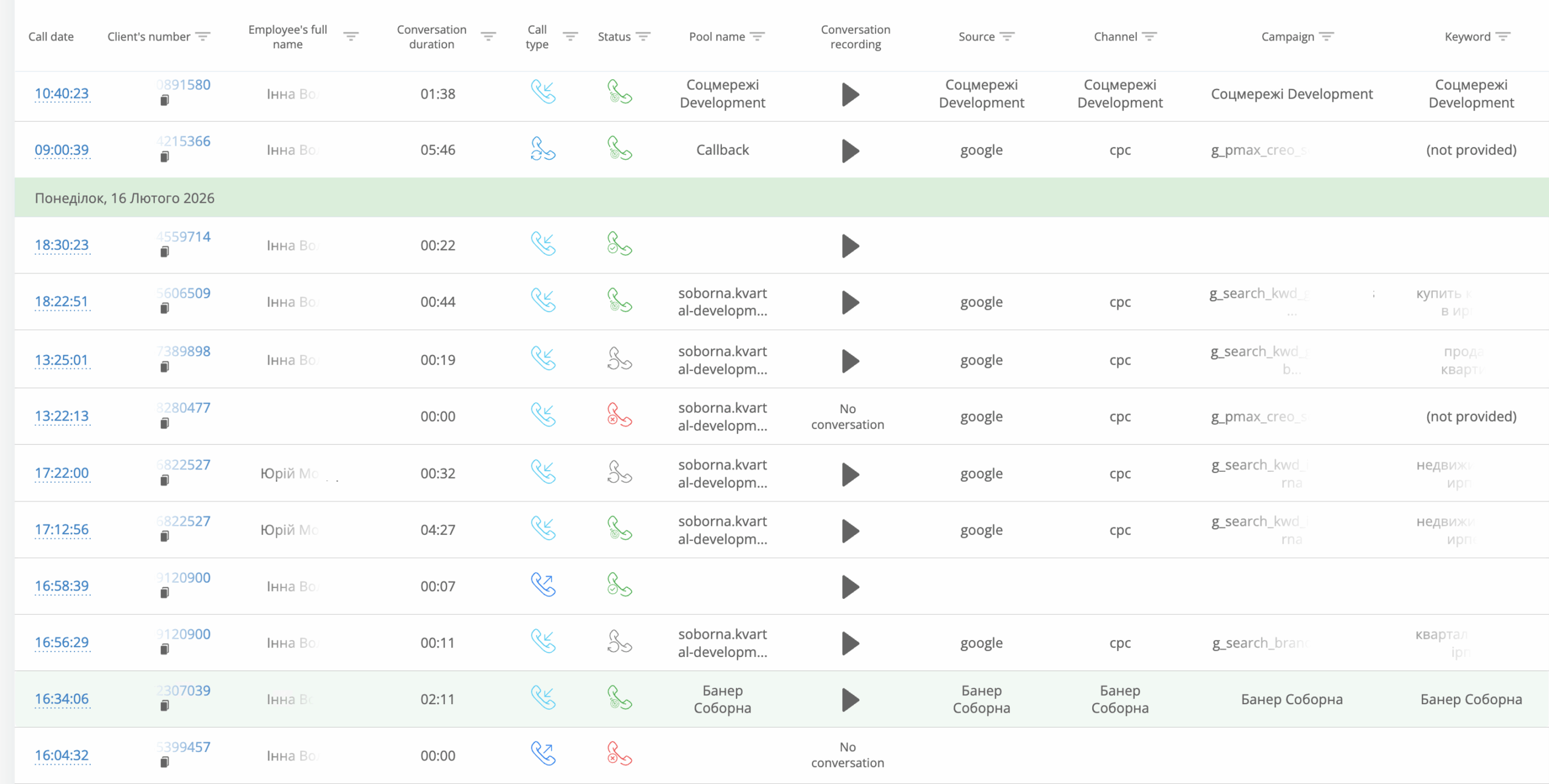
This information is also automatically sent to the G-plus CRM and shown in the lead record. Managers see not only the fact of the inquiry, but the full marketing context: which campaign started the communication and what exactly interested the client. They can start the conversation like: “Hello, I see you came from the ‘parking as a gift’ promo. Let me tell you more.”
Kvartal Development also uses call tracking data for deep marketing performance analysis. The team tracks conversions separately for each advertising channel and platform to understand which sources actually bring clients who buy. In particular, they compare results across platforms: if one channel delivers a significantly higher share of closed deals than another, it becomes a signal to rethink the advertising strategy.
This approach also helps solve a typical business problem — to determine where the drop happens: in marketing or in managers’ work. According to Yurii, in such situations the team first analyzes call recordings.
Call analysis also helps notice behavioral differences in audiences from different channels. For example, the company noticed that users from Google ads more often call right away, while users from Meta ads more often leave requests. Such observations help fine-tune communication and evaluate the effectiveness of each channel.
Callback as a way to catch “quiet” leads
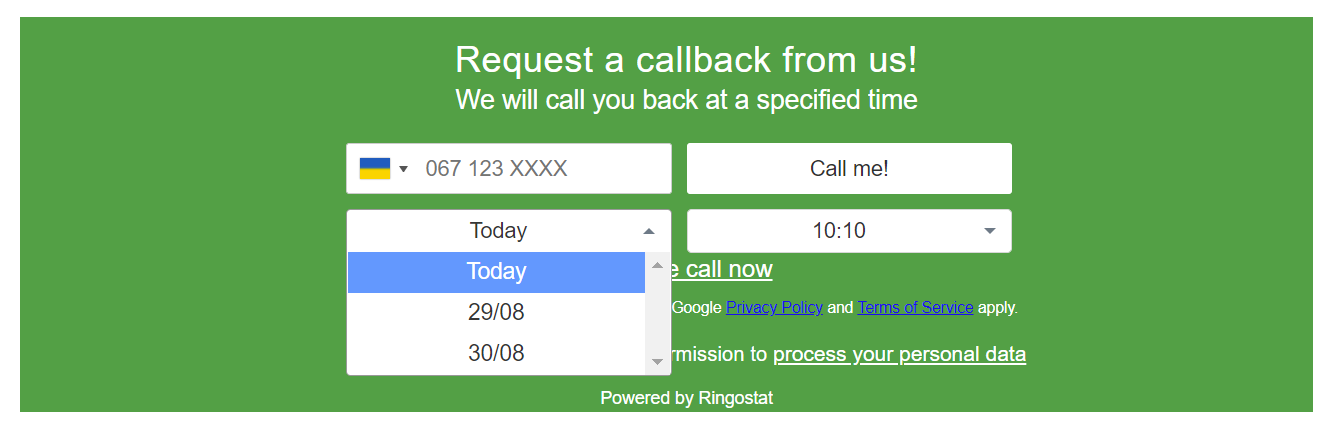
The developer project website also uses the Ringostat callback widget. It allows visitors to request a call if they are not ready to call right away. According to Yurii, this feature is especially useful late in the day, when potential buyers browse real estate on the website. They can leave a request and choose a convenient time for a manager to call back.
How communication is set up in the agency: control of mobile agents without losing flexibility
Unlike the developer direction, where calls go to the sales department, in the Kvartal Development agency communication with clients happens through agents who constantly work “in the field”: conduct viewings, consult clients, arrange meetings, and support deals.
This work happens mainly via mobile phones — classic IP telephony does not fit. For a long time, this was the weak spot: the company did not see a significant part of communication with clients and could not fully control the process. Also, without a system:
- some clients get lost;
- it is impossible to assess agents’ work;
- the business depends on the “human factor”.
FMC: mobile calls — in a single system
To solve this problem, Kvartal Development connected FMC (Fixed Mobile Convergence) technology from lifecell together with Ringostat. It works in a way that each agent can use their own mobile number and work in their usual format. But since it is linked to Ringostat:
- all calls are recorded in the system;
- call recordings are stored along with the full communication history;
- data is automatically sent to the CRM;
- management gets full transparency and can control the quality of client handling.
So the company kept agent mobility, while at the same time gaining full transparency of communication with clients:
- you can see how many calls each agent handles;
- you can listen to call recordings;
- it is easy to identify where leads are lost or communication quality drops.
How integration unites processes: all communication in one space
A key role in building a single system is played by Ringostat integration with G-plus CRM. It allows automatically sending data about all calls directly to the sales management system — without manual data entry or losing information.
For example, when a client calls for the first time, the system automatically creates a lead record in the CRM. After the call ends, a full set of data is immediately added to it:
- date and time of the inquiry;
- call status;
- client number;
- call recording;
- interaction history;
- inquiry source: advertising channel and campaign, keyword, creative.
The manager sees not just the fact of the call, but the full context: who called, with what request, and from where.
Client context does not get lost between managers
Since all calls are automatically sent to the CRM, the team works with clients not blindly, but in the context of all prior communication. Even if the client reaches another manager, the system contains the full interaction history, including notes from previous conversations. It is easy to pick up the communication immediately and answer to the point without making the client repeat information. This also creates a positive impression that the company remembers the client’s requests and understands their needs, which reduces the risk of losing the lead.
Call data available immediately after the conversation ends
An unexpectedly useful thing was that the call recording appears in the system immediately after the conversation ends, not after some time. So Kvartal Development managers can listen to the recording right after the call to capture key information in the client record without mistakes. This approach is especially important for sales departments where managers handle a large number of inquiries during the day.
One system for sales, communication, and marketing
As a result, Kvartal Development got a single communication system that combines:
- sales department telephony;
- agents’ mobile communication;
- CRM data;
- information about marketing sources.
This allows the company to control all calls, better understand inquiry sources, and increase team efficiency.
Reports and team performance control
For Kvartal Development, it is important to have tools that help control the work of both agents and sales managers — and Ringostat reports help the team lead do exactly that.
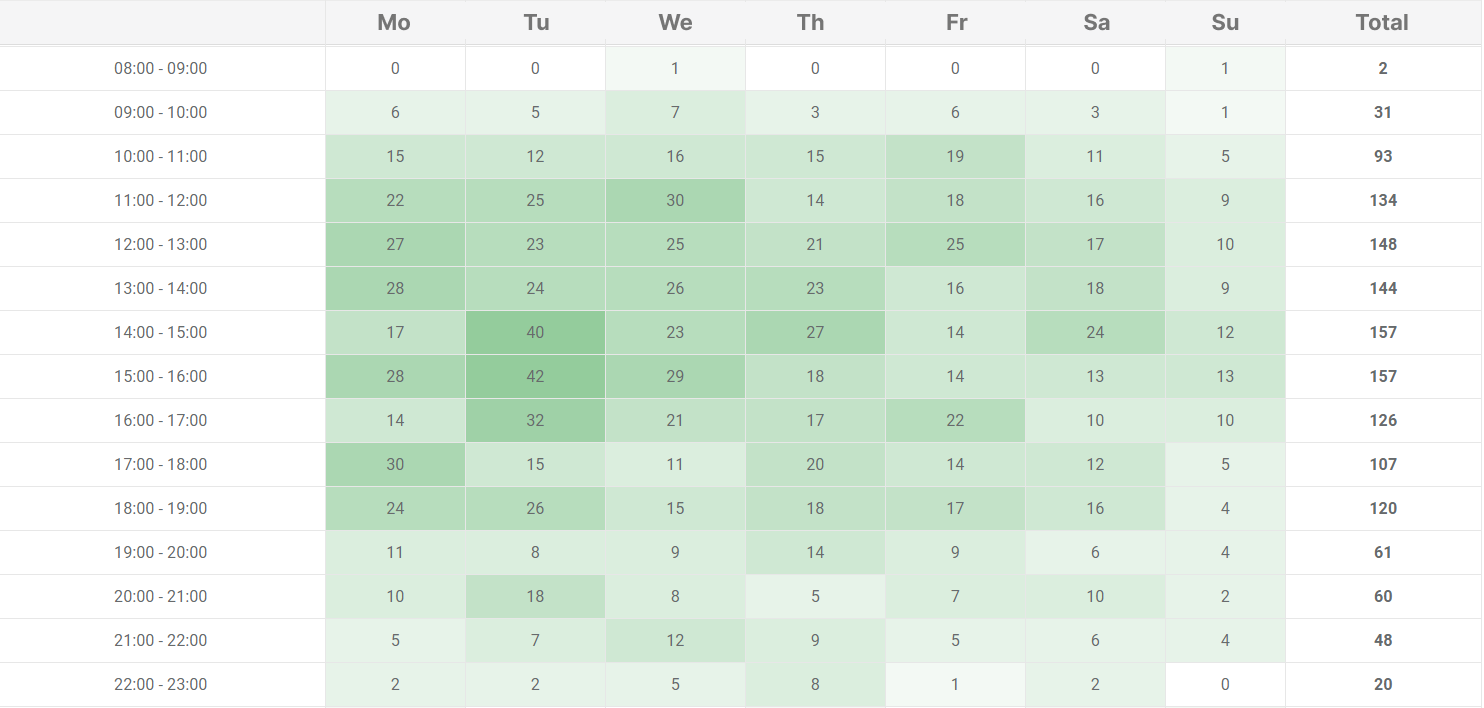
Yurii regularly reviews call statistics to assess team productivity. Reports show how many calls each employee answered and made, how many calls were missed, and how quickly employees call back. This data makes it easy to see who handles calls productively and who needs more attention.
Reports also help analyze team dynamics during the week. For example, you can see how managers’ activity changes from Monday to Friday. For example, at the beginning of the week activity is higher, and closer to Friday it can drop.
Another feature the team uses is listening to call recordings. Recordings help review complex client cases and improve managers’ work. A team lead can listen to the call, understand how the consultation went, and give recommendations when needed.
Reliable connection during energy crises
For real estate businesses, stable communication is critical. Potential buyers often call several developers and agencies at the same time, and a missed call often means a lost contact with a client.
According to Yurii, this problem became especially noticeable during periods of energy instability. That was when the difference between agents using integrated telephony and those working with regular mobile numbers became obvious.
The reason is simple: when calls do not go through a single system, it is much harder to track, store, and control them. If a manager misses a call, no automatic “Call back” task is created. And if the conversation happened in the morning, by the evening they will no longer remember the details and agreements — while a colleague can easily restore them by looking at the record in the system. The company also does not see lost inquiries in overall statistics. A client who was forgotten will likely simply reach out to another developer.
For employees whose numbers are connected to Ringostat via FMC, everything worked like clockwork: calls answered or made from mobile phones were recorded in the CRM, enriching the overall communication context. And the company kept control over calls.
Results: one communication system for two different businesses
Thanks to implementing Ringostat telephony and call tracking integrated with G-plus CRM, Kvartal Development built a single communication system for two business directions — the developer and the real estate agency.
Key results:
- 100% of calls in the system: the company does not lose inquiries and sees the full picture of work with clients;
- Transparent marketing analytics: it is clear which advertising channels actually bring leads and sales;
- Control of mobile agents: even calls from personal phones are recorded and available for analysis;
- A single client work context: the full communication history, call recordings, and inquiry sources are collected in the CRM;
- A team management tool: a leader sees managers’ productivity, controls missed calls, and communication quality;
- Stable communication in any conditions: the system helps avoid losing inquiries even during crises and outages.
For the real estate market, where each call can be the start of a long purchase journey, such a system is critically important.
Then we understand what is happening with clients and how the team works,”a drop of about 30% during crisis periods.”
