


Artificial intelligence has transformed the sales landscape. According to Gartner, sales reps who effectively use AI-powered tools are 3.7 times more likely to meet their quota. Meanwhile, Bain & Company asserts that AI helps teams win over 30% more deals.
However, not every attempt to implement artificial intelligence is successful. As a team that develops and refines AI solutions, we know how to effectively integrate this technology into a sales department’s workflow. In this article, we’ll break down what truly works, the common challenges of implementation, and the trends that will define the future of AI in sales.
How AI Empowers Sales Teams
Artificial intelligence has already become a part of the daily routine for many sales reps. It’s not just another tool in the tech stack — it’s the next stage in sales evolution. AI automates routine tasks, analyzes data, highlights risks, and provides actionable recommendations. As a result, it helps teams make faster, data-driven decisions without relying solely on intuition.
Consequently, sales reps have more time to engage with clients and work more productively. Their supervisors can leverage more accurate forecasts for informed decision-making and better oversee the team’s performance.

But where data is incomplete or poor quality, and where there’s a lack of discipline in CRM usage or the skills to interpret algorithmic signals, AI simply won’t work.”
Where AI Delivers Real Business Value
The most effective AI-powered solutions fall into four categories: conversation intelligence, automation, forecasting, and personalized outreach.
Conversation Intelligence
AI-based tools are revolutionizing how calls and demos are evaluated. Without them, a supervisor can only review a tiny fraction of recordings. Artificial intelligence, however, can analyze every conversation across dozens of parameters, transcribe it, provide a summary, and assess the sentiment of all parties. This is precisely what Ringostat’s AI-powered speech analytics offers. Furthermore, language barriers are no longer an issue — the system understands over 50 languages, transcribes calls in a chosen language or translating them into English.
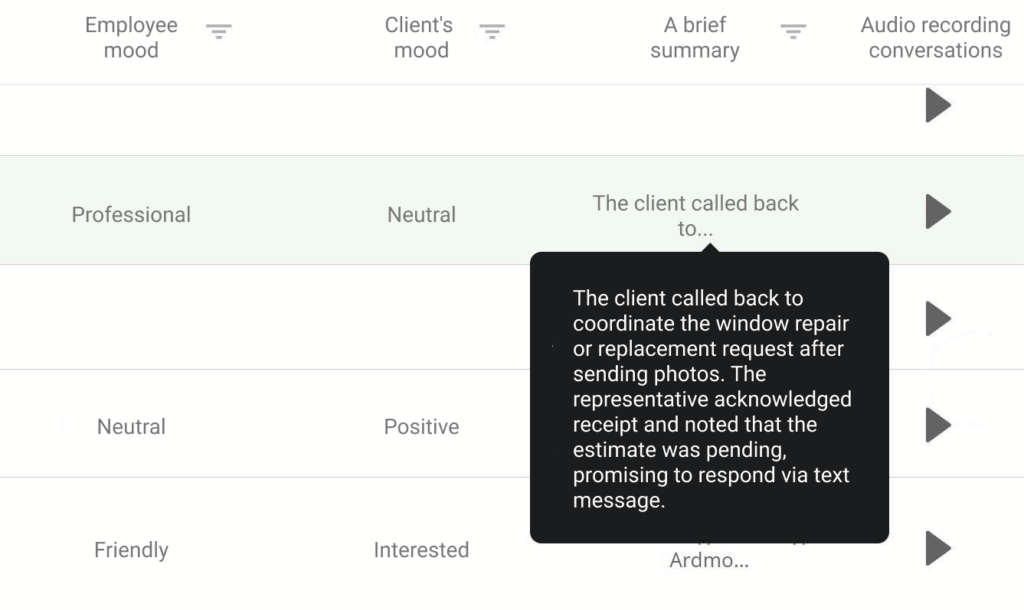
With these insights, a supervisor can provide actionable feedback and coach the team, addressing mistakes and scaling successful strategies — all while being freed from hours of manual call analysis. For instance, Ringostat AI saves the management at Andriy Krupkin’s Sales Bureau approximately eight hours of work per week.
Automation
Intelligent systems handle routine tasks like logging call outcomes, updating CRM fields, and scheduling follow-ups. According to HubSpot, time-saving is one of the most significant advantages of using AI in sales. 64% of sales professionals report that AI saves them one to five hours per week.
This frees up the team to focus on customer-facing activities, which can be invested in driving sales and, ultimately, increasing company revenue.
Insights and Forecasting
80% of sales reps using AI state that it’s easy for them to gain buyer insights that help close deals. For teams without AI, this figure drops to just 54%. Professionals surveyed by Salesforce identified improved forecast accuracy as one of the areas where AI has the most significant impact.
For example, the technology can analyze CRM data to identify at-risk deals, e.g., leads with low engagement or those stuck in one pipeline stage. It can also determine the probability and timeline for closing a deal based on historical data — emails, calls, deal size, and decision-maker involvement.
This allows sales leaders to adjust their targets, allocate resources to more promising opportunities, and intervene before a client is lost. In this way, AI transforms raw data into strategic, actionable recommendations.
Personalizing Sales Pitches
According to the HubSpot report The State of AI in Sales, 42% of sales reps use generative AI for communicating with prospects. This enables them to personalize their messaging more effectively without spending extra time.
For instance, AI can quickly analyze key points from previous interactions, a client’s LinkedIn profile, and any mentions on their company’s website. Based on this information, it can draft a highly personalized email proposal.
This approach not only saves the team time but also boosts their efficiency. The same study reveals that 70% of sales reps using AI for outreach report a higher response rate.
Common Implementation Challenges
Despite the technology’s immense potential, integrating it into existing sales processes is not always seamless. Here are some of the main hurdles and how to overcome them:
- Lack of Staff Training
33% of sales professionals surveyed by Salesforce reported that their teams lack the necessary skills to use smart tools effectively.
Solution: Create structured training programs. You can build on existing educational initiatives, such as the free “AI Course: From Beginner to Expert,” developed with support from the Fractal group of companies.
- Limited Resources
One-third of the study’s participants stated that their teams lack the personnel or budget to support the new technology.
Solution: Start small. Launch pilot projects that demonstrate a quick return on investment (ROI), such as automating call logging or lead scoring. Reinvest the time and money saved into a broader implementation.
- Data-Related Uncertainty
According to Salesforce, most sales professionals are skeptical about the quality of data within their own companies.
Solution: Implement a continuous data governance process. Regularly clean CRM records, establish validation rules, and assign responsibility for data quality. Proper data hygiene directly improves model accuracy and boosts reps’ confidence in the insights they receive.
- Fragmented Systems
When CRM, telephony platforms, and analytics tools are disconnected, it limits the potential of AI.
Solution: Prioritize integration. Choose platforms with open APIs or native CRM connectors. Consolidate your deal and interaction data first, then add AI-powered solutions on top.
An alternative is an omnichannel system with integrated AI tools, which is precisely what Ringostat offers. Your team can view calls, messages, and caller information in a single application.

They’ll also gain valuable insights for cross-selling and upselling. The result is fewer missed opportunities and higher conversion rates. As a leader, you can easily track your sales team’s performance, including through AI-powered speech analytics.
- Resistance to Change
Many sales reps are accustomed to relying on experience and intuition, and they may see AI as a hindrance rather than a help.
Solution: Highlight early wins. Show how AI reduces routine work and helps close deals faster. Demonstrate the benefits of new tools to your top performers to turn them into AI ambassadors within the team.
Four Tips for Choosing the Right AI Tools
The primary criteria for selecting AI tools for your sales department are alignment with business objectives and return on investment. The most successful solutions integrate organically into existing workflows and prove their value within the first few months.
Here are our tips for finding the best tool for your needs.
- Start with Clear Business Goals
Define the specific problem the new tool needs to solve: reducing manual workload, improving forecast accuracy, or shortening the sales cycle. Without a clear use case, implementation projects lose focus and drag on, making it impossible for the team to see clear benefits and for you to measure ROI.
- Calculate the Total Cost of Ownership
AI implementation involves more than just the product’s price tag; it includes costs for integration, data preparation, and user training. Consider the time and effort required to use and maintain the tool. A cheaper but unrefined solution could end up costing you more in the long run.
- Insist on AI Transparency
Opt for systems that explain their decision-making logic — why a particular lead is flagged, or how a forecast was generated. This builds trust and accelerates user adoption.
- Evaluate Scalability and Data Governance
Choose a solution that can easily scale to more users and other use cases. Ask vendors how they handle data ownership, train their algorithms, and ensure regulatory compliance. Your team must maintain control over your data and processes as the system evolves.
How to Measure AI Effectiveness
To determine if a new technology is truly delivering results, define your success metrics during the implementation phase. Key metrics to watch include:
- productivity gains: time saved per employee or per process, e.g., CRM data entry, or a shorter sales cycle duration;
- forecast accuracy: compare performance before and after AI implementation;
- performance dynamics: track conversion rates, win rates, and outreach response rates, depending on how the tool is being used.
There are several ways to link improved metrics to AI adoption. You can start by running an experiment with a pilot group of sales reps who use the AI tool for six to eight weeks. Compare their results during this period to their performance before the pilot and to the rest of the team.
Once the system is scaled, you can track how frequently sales reps interact with AI features like forecasting or recommendations. Correlate this usage data with performance metrics, such as win rates. This approach is beneficial because it doesn’t disrupt normal workflows.
Alternatively, you can compare the team’s overall results before and after AI implementation. However, this method is best suited for larger departments with extensive historical data, as it’s crucial to account for seasonality, marketing campaigns, and other external factors to avoid an inaccurate assessment.
A supplementary method is to use surveys and CRM analytics. Ask your team how much time AI has saved them or whether its suggestions have been helpful. Then, cross-reference their answers with actual performance data for each rep or team. If subjective feedback and objective metrics both point to improvement, AI is indeed making a difference.
Trends in the Use of AI in Sales
Artificial intelligence continues to evolve, transforming how companies analyze data and interact with customers. Gartner predicts that by 2027, 95% of a seller’s workflow will be initiated by AI, up from less than 20% in 2024. Here are the trends we believe will have the greatest impact on AI in sales.
AI Agents
Companies will gradually transition from assistive tools to autonomous AI agents. These agents can already source prospects, initiate outreach, and prepare proposals. In time, they will likely manage the entire sales cycle, from first contact to closing the deal. This will shift the role of a sales rep from an “executor” to a “strategist” who directs the agents’ work.
What this means for business:
- a shift in team roles, with AI agents taking over some SDR functions;
- the need for strategies to govern and verify agent actions;
- a lower cost per sale thanks to automation;
- a revision of KPIs, moving from metrics like “number of calls” to the effectiveness of human-AI collaboration.
Hyper-Personalization
AI already enables the creation of messages tailored to individual clients by analyzing their behavior, market, and interaction history. This process is set to scale in the coming years. Buyers increasingly expect sellers to understand their specific needs, not just recite a script. AI will generate content and offers that feel personal, even when targeting thousands of customers.
What this means for business:
- scaling a “human touch” without increasing headcount;
- higher conversion rates, especially in B2B;
- a critical focus on data quality, e.g., in the CRM, as the foundation for effective personalization;
- training for sales reps to manage this process through templates, logic, and quality control.
Real-Time Forecasting
In traditional forecasting, managers pull data from a CRM, create reports in Excel, and analyze past trends. By the time a decision is made, the situation may have already changed. Machine learning models can analyze calls, emails, customer activity, and CRM updates in real time. This allows for forecasts that are continuously updated without human intervention.
What this means for business:
- more closed deals, as leaders can spot at-risk deals and intervene before they stall;
- more accurate revenue forecasting, as well as resource and bonus planning;
- an increased focus on system integration — CRM, calendars, email, and calls, to give AI the complete picture.
Ethics, Trust, and AI Regulation
As AI becomes more deeply integrated into sales and other business processes, its operational transparency and data protection are becoming paramount. New legislative frameworks, such as the AI Act, are establishing new standards of accountability. Companies that can explain how their models work and why they make certain decisions will build stronger customer trust.
What this means for business:
- a focus on tools that are not only effective but also transparent (explainable AI);
- the need to develop and continually update internal policies on AI and data usage to comply with international standards.
How to Win in the New Sales Reality
AI in sales is more than just hype — it’s a powerful tool for increasing a sales team’s productivity and effectiveness. However, it’s not a magic bullet. Success depends on how a company integrates AI: the quality of its data, the training of its sellers, and whether its leadership understands where the technology truly generates value.
Today, AI is already helping to personalize offers, generate communication content, improve forecasts, and analyze customer conversations. In the years ahead, hyper-personalization, autonomous agents, and real-time forecasting will become even more prevalent. The winners in this new environment will be those who think strategically: cultivating a data-driven culture, investing in staff training, and demanding algorithmic transparency.
AI doesn’t replace sales reps — it empowers them to perform better, boosting sales and revenue. The competitive advantage will belong to the teams that can best adapt these new technologies to their processes and strategically leverage their strengths.