


Most heads of sales are confident that they control the situation with calls. Until they try to answer a simple question: how many leads did we lose yesterday? Not approximately, but exactly: how many people didn’t get through, didn’t receive a reply in chat or messenger, didn’t get a callback. And it often turns out that some calls were never answered, and others were simply forgotten. In this article — 20 questions that will help you quickly check whether you have a communication control system in place, or whether your sales are partly driven by chance.
Visibility and Control
Let’s start with the basics — can you see everything that is happening in your sales department? If you don’t see what’s happening, you don’t manage it.
1. Are all incoming calls recorded in your system?
In many companies, some calls bypass the system: managers take calls on their personal mobile phones, clients call the main number, and then the inquiry gets lost. If technical failures occur, data disappears without a trace. Without a complete picture, you cannot draw conclusions about your sales team’s performance.
2. Do you see all missed calls?
If you have to open multiple reports in different systems, ask managers, and manually compile data — you don’t have a clear and transparent control system.
A missed call “lives” very briefly — if you don’t notice it and call back, it is forgotten, along with the potential customer.
3. Do you know exactly who missed the call?
“We had missed calls” is not management. Management is when you can see: this manager missed 5 calls today — and you understand why. Without personal accountability, the problem always belongs to “no one.”
4. Can you see managers’ statuses in real time?
Without real-time control, calls are distributed randomly: someone is overloaded and cannot answer, someone is handling other tasks in parallel, and someone simply set their status to “offline” and dropped out of the process.
What does this mean and what should you do?
If you answered “no” to even 1–2 questions, you do not have a complete picture of what is happening in your sales department. And this is the baseline level. Without it, analytics, KPIs, and control are impossible.
What should you do first:
- consolidate all calls into a single system, including mobile calls if managers use personal numbers for work;
- set up a unified call log;
- make missed calls visible;
- assign responsibility for calling back missed calls.
Before optimizing anything, you need to see the real situation — fully and accurately.

We believe IP telephony is not just about making calls. It’s a powerful tool for analyzing conversations at every stage of the funnel and across all business processes. It helps sales teams make sound management decisions.
Many business owners and managers still see IP telephony as just a tool for calling and recording conversations.
In reality, Ringostat offers a much broader view of business processes and provides end-to-end visibility into sales team performance.
Handling Inquiries
Even if an incoming call is received and appears in reports, it does not mean it was handled properly.
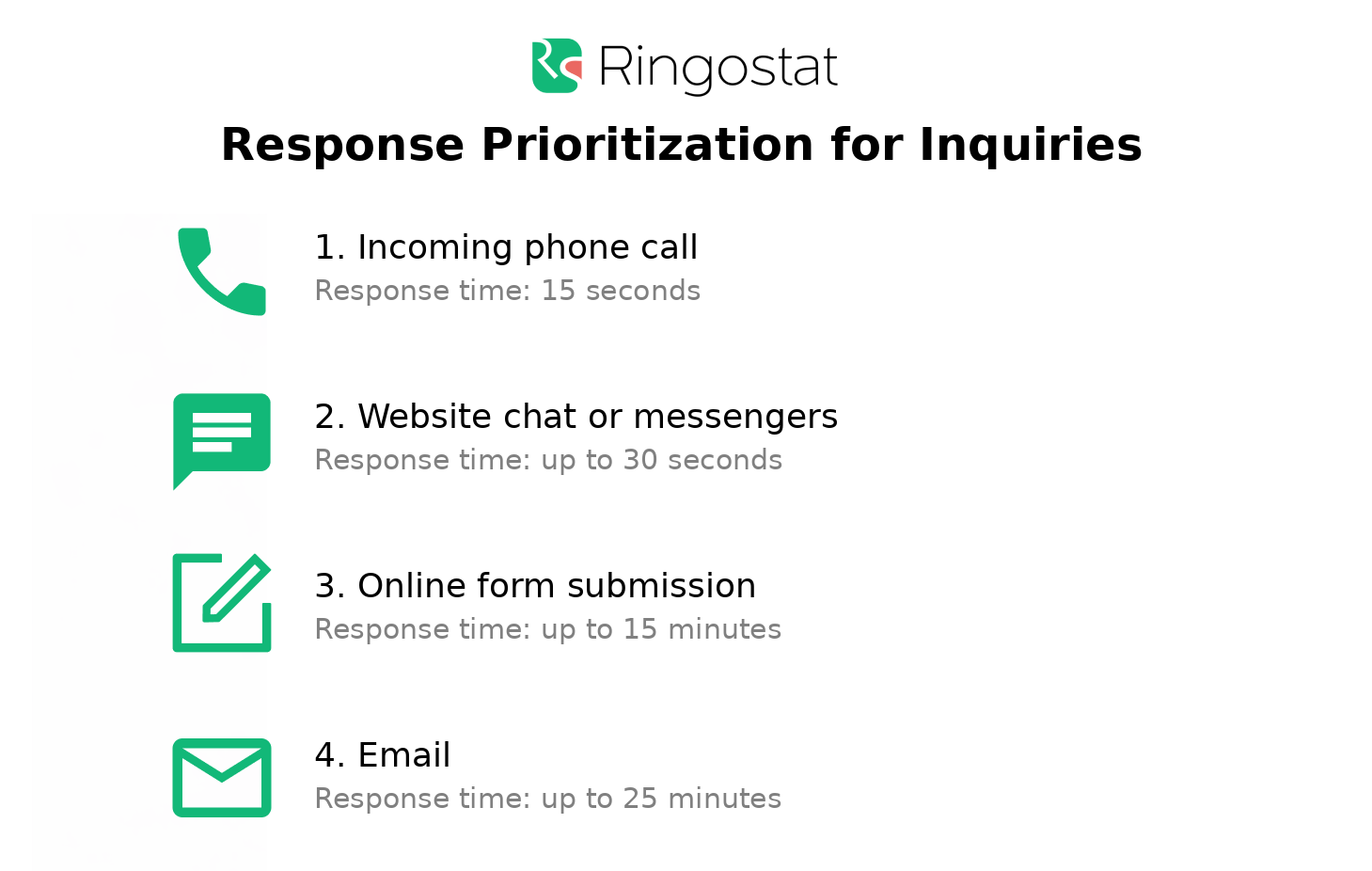
5. Do you have rules for how quickly calls must be answered?
SLA (Service Level Agreement) is a service standard that defines how quickly and how your team should respond to customer inquiries. Typically, sales departments follow these standards:
- call answer time — within 10–15 seconds;
- callback time for missed calls — within 5–15 minutes.
Without an SLA, each manager acts “depending on the situation”: if they are free, they answer immediately; if not, they may call back an hour later. For the customer, this is the difference between “they pick up the phone” and “I couldn’t get through.” In the latter case, it almost always means a lost lead.
6. Do you monitor response time?
Let’s say the rules exist, but without control, they won’t work. Managers do not measure their own responsiveness — they simply work as they are used to. And the manager only sees the result at the end of the month — usually in the form of an unmet target.
7. Do you track how managers handle missed calls?
A typical situation: a manager thinks they will call back later, then other tasks appear, and the call gets lost. Meanwhile, the client has already contacted competitors. And this happens regularly — just unnoticed.
8. Is there a separate list of missed calls that have not yet been handled?
If such a list does not exist, no one knows how many calls have been processed and how many “hot” inquiries are still waiting for a response. There is even a risk that someone will be called twice, while someone else is completely forgotten.
What does this mean and what should you do?
If there are no clear rules and control over call handling, response speed becomes random. And in sales, time = money. Here’s what you should do:
- define SLA (Service Level Agreement): response and callback times;
- add control of these metrics to reports or dashboards;
- create a separate report for missed and unprocessed calls and introduce a rule: by the end of the day, the list must be empty.
At this stage, you move from “our managers try their best” to a managed communication process.
Process Design and Workload Distribution
The problem may not be in irresponsible employees, but in a system that cannot handle the workload.
9. Do you know when your peak call hours are?
Most managers answer this intuitively — for example, that Mondays around noon are the busiest, and by Friday the pressure decreases. But in reality, it may be completely different, with peaks occurring at unexpected times — for example, in the evening when people return from work and start solving personal or household issues. Or even on weekends. Without accurate data, you cannot adapt to your potential customers.
10. Does your team’s schedule match peak call hours?
If during peak hours your team is having morning coffee, scheduling meetings, taking breaks, or already leaving for the day — there is simply no one to answer calls. And this is not a team problem, but a planning problem.
11. Do you have a call queue set up?
If you don’t have a call queue, multiple calls cannot come in at the same time. You will answer only one call, while another caller will hear a busy tone. Most likely, they won’t be motivated enough to call 3–4 times in a row — they will simply look for another product or service.
A call queue is the key tool that allows you not to lose inquiries during peak load.
12. Is the workload distributed evenly among managers?
Without proper distribution, imbalance inevitably occurs. The strongest managers are overloaded, while newcomers are underloaded. This affects the overall team performance — you lose both in quality and quantity.
What does this mean and what should you do?
If the team cannot keep up with handling calls, it is not always a people problem. Sometimes it’s about poorly designed processes. Here’s what you should do:
- analyze actual call peaks by hours and days of the week;
- adjust work schedules based on peak and off-peak periods;
- implement a call queue to avoid losing calls;
- balance workload distribution within the team.
This usually allows you to optimize workload without hiring additional staff.
Communication Quality
Control is not only about whether the call was answered, but also about what was said.
13. Are calls recorded?
Without call recordings, you cannot verify how managers communicate with customers, and you can only rely on what the manager says — which is not always accurate.
14. Do you analyze managers’ conversations?
Even if recordings exist, they are often not reviewed — usually due to managers being overloaded, or because the tool is underestimated. This harms sales, as mistakes are repeated from one conversation to another. For example, a manager does not ask questions, interrupts the client, or does not agree on the next step. Meanwhile, successful approaches are not scaled across the team.
15. Do you understand why clients do not buy after a call?
If clients say “it’s too expensive” or “it doesn’t suit me,” that is not the real reason for losing a deal, but a typical objection that needs to be handled properly. Without analyzing conversations, you do not see the real causes of low sales: unmet needs, weak presentation. And sometimes — a lost contact that quietly drops out of the funnel.
16. Do you have standards or scripts for conversations?
Without standards, each manager conducts conversations in their own way. Sometimes charisma really works, but the unique approach and experience of strong salespeople cannot be scaled across the entire team. Scripts, on the other hand, deliver consistent results.
What does this mean and what should you do?
Even if all calls are answered, this does not guarantee sales. Without communication quality control, the team may consistently fail to “push” clients to a purchase. Here’s what you should do:
- define basic conversation standards;
- start regularly reviewing calls, even selectively;
- fix recurring mistakes;
- highlight and replicate successful approaches.
Here, you influence not the number of handled calls, but the conversion from call to sale.
Customer History
A sale does not start with “Hello,” but with understanding who is calling.
17. Does the manager know who is calling before picking up?
If the manager only sees a number, they start the conversation from scratch. Time is spent figuring out who the caller is, where they are from, and what they need. As a result:
- the conversation becomes longer;
- the manager repeats basic questions instead of getting to the point;
- the client feels slight frustration that they are “not remembered.”
If the manager has at least minimal context before the call — for example, the client’s name, or even better, access to the full communication history — the conversation immediately becomes more meaningful and has a higher chance of leading to a sale.
18. Are calls from existing customers routed to the responsible manager?
If regular customers are handled by different employees each time, context is lost, along with speed and quality of communication. And with that — part of your deals.
What does this mean and what should you do?
If the manager lacks context, every call starts from scratch. This slows down the process and reduces the quality of interaction, as the client does not want to repeatedly explain their situation.
What should you do:
- integrate telephony with CRM so that call data is automatically recorded;
- enable access to customer data during the call;
- set up routing of calls from existing customers to the responsible manager.
Read also — Telephony integration with CRM: benefits that are underestimated.
Telephony isn’t about a carrier plan. It’s a tool that helps identify bottlenecks in your sales process and make the right decisions to improve performance.
Automation
Finally, the silent killer of efficiency — routine manual work.
19. Is call data automatically transferred to CRM?
If a manager manually creates a contact and enters call details after each conversation, it almost always leads to:
- wasted time;
- risk of errors;
- forgotten and lost contacts.
20. Are tasks created automatically, including after missed calls?
If a manager has to remember to call back after a missed call, they won’t. Not because they don’t want to, but because they are overloaded. The same applies to other tasks: sending documents, issuing invoices, scheduling meetings, etc.
An automatic task is the minimum required to avoid losing inquiries and sales due to human error. Without it, the process relies on managers’ memory — and in practice, memory fails.
What does this mean and what should you do?
If the process relies on managers’ memory, it is not scalable. Moreover, a manager may leave, get sick, or go on vacation — and take processes, agreements, and context with them.
What should you do:
- automate call logging in CRM to avoid losing any details;
- automatically create tasks based on calls, messages, and agreements;
- minimize manual work.
This reduces workload, stabilizes the process, and eliminates human factor risks.
How to evaluate the result?
Count how many questions you answered “yes” to:
- 16–20 — you have a system, and it works;
- 10–15 — the system exists but has critical gaps;
- less than 10 — your process is partially or completely unmanaged, and you are constantly at risk of losing leads and sales.
Important: even 2–3 weak points can affect the overall result much more than it may seem at first glance.
Conclusion
Calls in the sales department can look like a chaotic flow, or they can be a managed process where it is clear what is happening and who is responsible for what. The difference between these states is not in the number of inquiries or the skills of managers, but in whether you have built a system for handling calls.
This checklist helps you see whether that is the case — and if not, where exactly the breakdowns occur. Usually, it is not one critical mistake, but several weak points that together create the feeling that the process “somehow works,” even though the result is unstable.
It is important not to try to fix everything at once, but to first see and understand the full picture. Because calls are only part of customer communication. Inquiries come from different channels, are handled by different people, and go through different processes — all of which also affect the result.
